
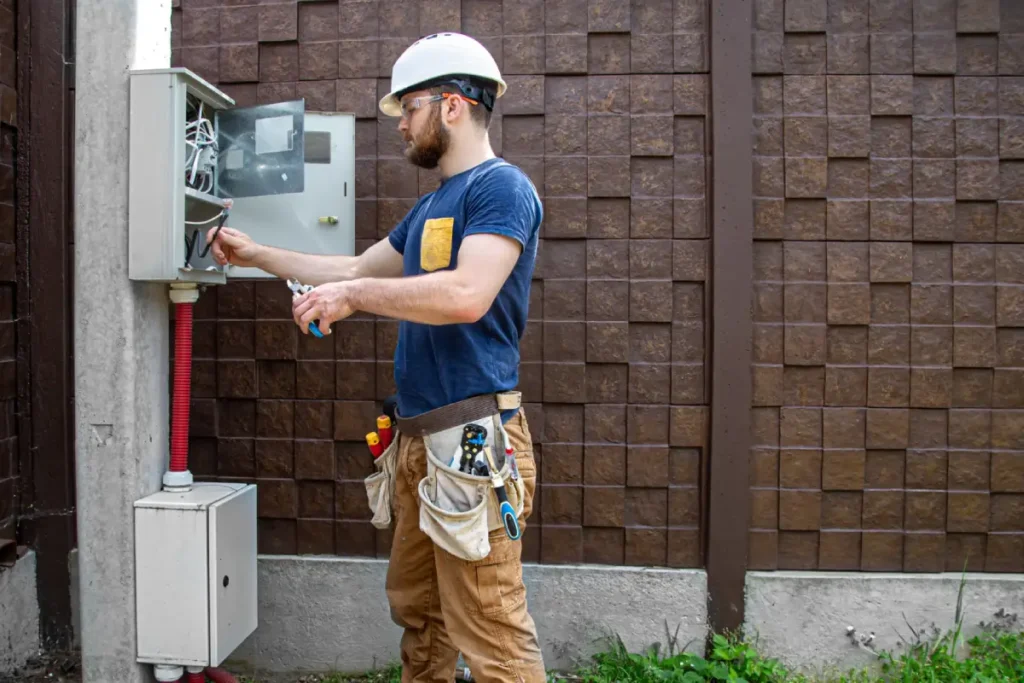
Written and technically reviewed by Steven Watt, NICEIC Approved Contractor enrolment 620239. Last reviewed 13 September 2026.
Outdoor lighting installation should make it easier to see your steps, unlock the door and use the garden after dark. The right design puts light where you need it, with fittings and wiring chosen for the weather and the way you use your home.
For an initial cost comparison, published UK guides put labour for a straightforward exterior wall light at around £100 to £150, or £150 to £200 for a security light on an existing circuit. Fittings, additional wiring and other work can increase the total considerably. A garden lighting scheme needs its own survey and quotation.
In Scotland, you also need to consider the correct electrical protection, any relevant permissions and the effect on neighbouring homes. At Faithful Spark Electricians, our outdoor lighting installation service covers homes across Aberdeen and Aberdeenshire, from a replacement entrance light to a planned garden installation.
How much does outdoor lighting installation cost
The distance from a suitable electrical supply often matters as much as the number of lights. Replacing a fitting beside the back door is a different job from installing lights along a driveway, even if the fittings themselves cost the same.
The figures below are published UK labour benchmarks, not Faithful Spark prices or complete supply and installation quotations. They come from Checkatrade’s exterior lighting cost guide, updated in July 2026.
| Straightforward installation | Published labour range | What to check before budgeting |
|---|---|---|
| One mains exterior wall light on a suitable existing circuit | £100 to £150 | Whether the fitting, materials, testing and VAT are included in your quotation |
| One outdoor security light on a suitable existing circuit | £150 to £200 | Whether extra cabling, sensor adjustment or access equipment is needed |
The source describes its figures as mainly labour only and does not clearly establish VAT treatment for each item. Ask for a written total including VAT where applicable. Avoid comparing a labour figure with a complete installation price.
What makes a lighting quotation higher or lower
A useful quotation explains the work behind the price. These are the main things to discuss before deciding which proposal suits your budget.
The fittings you choose. A basic wall light, a decorative lantern and a fitting designed for an exposed coastal position can have very different purchase prices. Check whether lamps, drivers and mounting accessories are included.
The cable route. A short route through an accessible garage is usually simpler than one that crosses finished paving. Underground routes can involve excavation, protection, backfilling and reinstatement, as well as the electrical work.
The existing installation. Your electrician needs to establish whether the proposed supply is suitable. Necessary repairs or protective device changes should be identified and explained, rather than assumed to be included in the price of a light.
Access and the building fabric. A fitting above a conservatory or on an awkward elevation may need access equipment. Granite, render, insulation systems and delicate finishes also affect the installation method and the time needed to leave a tidy result.
Controls and commissioning. A switch, a movement sensor and an app controlled system involve different equipment. Allow for setting up the controls and checking that the lights operate as intended.
A worked example of a complete lighting budget
Suppose you are planning two wall lights beside a patio. For illustration only, allow £100 for the pair of fittings, £180 for installation labour and £40 for cable and accessories. Those assumed amounts total £320 before VAT, or £384 with 20% VAT.
This is an arithmetic example, not a quotation or a claim about the average price. It assumes a suitable existing supply, straightforward access and no excavation or remedial work. Changing those assumptions changes the budget.
The useful lesson is to price the complete job. Ask who supplies the lights, how they will be controlled and what happens if the existing wiring needs attention. If you have a spending limit, say so before selecting fittings.
Ways to control the cost without compromising the installation
Plan lighting before new paving or decking is finished. Agreeing cable routes with the electrician and landscaper at that stage can avoid opening up completed work later.
Prioritise the entrance, steps and the route you actually use. Decorative lighting can follow when the budget allows, provided any future provision is designed into the first stage.
If you want to supply the fittings, send the product links before ordering. Your electrician can check the mounting arrangement and intended location. This is particularly helpful with lights bought online where a photograph reveals little about the terminals, seals or replacement parts.
Plan outdoor lighting around everyday use
Walk around the property after dark before making a shopping list. Notice where you struggle to see a change in level, where you stand while opening a gate and whether the existing light shines into your eyes.
A garden that looks attractive from the kitchen may still be awkward to walk through. Think about the view from inside and the experience of somebody arriving at the door.
Start with the routes people use
Mark the front door, parking space, side passage, steps and any route to a shed or bin store. Include places you use in winter, when decorative summer lighting may not be switched on.
The light needs to reveal the walking surface and changes in level. A bright fitting positioned behind you can leave your own shadow across the step you are trying to see.
Consider visitors as well as the household. Somebody unfamiliar with the garden may not know that a path narrows beside a planter or drops down to the patio. Clear, even illumination is more useful here than a dramatic lighting effect.
Separate practical lighting from decorative lighting
You may want the front entrance to respond automatically when you arrive, while the patio lights stay on during dinner. Putting everything on the same control can make both uses inconvenient.
Sketch separate groups for access, seating and features. These groups do not necessarily need separate electrical circuits, but they should have a sensible control arrangement.
Keep the plan proportionate. A small courtyard might work well with two carefully positioned wall lights. A large garden may benefit from several groups, especially where the house, terrace and outbuildings are used at different times.
Look at the fittings during daylight too
Outdoor lights remain part of the house when they are switched off. Check their size against the door, wall or fence, and consider how the cable will reach them.
Ask to agree the mounting positions before drilling starts. This is especially useful beside symmetrical doors, on decorative stonework or where a fitting could conflict with a downpipe, gate or opening window.
Choosing lights for doors paths patios and gardens
Choose the type of fitting according to the job it needs to do. Using the same light everywhere can leave some areas overlit and others difficult to see.
| Area | Options worth considering | Main design question |
|---|---|---|
| Front or back door | Shielded wall light or suitable bulkhead | Can you see the lock and threshold without glare |
| Steps and a narrow path | Directed wall lights or step lighting | Are changes in level visible from both directions |
| Patio or seating area | Warm wall lighting or suitable outdoor decorative lighting | Is the light comfortable when you are seated |
| Driveway | Directed wall lights or carefully positioned bollards | Does the light help parking without dazzling drivers |
| A garden feature | A focused fitting aimed at the chosen feature | Can the effect be achieved without lighting the boundary or sky |
Brightness and colour temperature
Lumens describe the amount of light a fitting produces. Watts describe electrical power consumption. When comparing LED lights, look at the light output and beam pattern, as well as the wattage.
A narrow beam can look intense on one patch of ground while leaving the rest dark. A broader, controlled distribution may be more useful for a doorway or walking route.
Warm white light, often around 2700K to 3000K, is a sensible starting point for a domestic seating area. Try to keep neighbouring fittings consistent unless there is a clear reason for a different appearance. These are design choices, not a universal rule for every garden.
Integrated LEDs or replaceable lamps
An integrated LED fitting can offer a neat appearance and a controlled beam. Before choosing it, ask what happens if the LED module or driver fails and whether those parts can be replaced.
A fitting with a replaceable lamp can make future maintenance simpler. However, the lamp still needs to match the fitting’s instructions and any dimmer or enclosed housing requirements.
Recessed lights need more planning
Ground and decking lights can look discreet, but the installation must account for water, drainage and access for maintenance. A fitting installed in a low spot may face conditions very different from a light mounted on a wall.
If vehicles might pass over a fitting, it must be specifically suitable for that loading. An IP rating alone does not tell you whether a light can withstand a car tyre.
Outdoor lighting IP ratings explained
An IP rating describes an enclosure’s protection against solid objects and water under specified tests. It helps you compare products, but it does not replace checking the manufacturer’s intended use and installation instructions.
The first digit concerns solid objects and dust. The second concerns water. Here is a practical reading of common ratings, using the definitions in the IP rating guide published on RS DesignSpark.
| Rating | What it describes | What it does not establish |
|---|---|---|
| IP44 | Protection against objects of 1 mm and larger, and splashing water | Suitability for water jets or immersion |
| IP65 | Dust tight and protected against water jets | Suitability for submersion |
| IP66 | Dust tight and protected against powerful water jets | Suitability for permanent immersion |
| IP67 | Dust tight and protected against temporary immersion under specified conditions | Suitability for every permanently wet location |
| IP68 | Dust tight and protected against immersion under specified manufacturer conditions | Unlimited depth or suitability for every underwater application |
There is no single IP number that makes every fitting suitable for every outdoor position. A sheltered porch, an exposed wall and a fitting beside standing water need different assessments. Manufacturer Faro Barcelona’s IP guidance also distinguishes between these locations. Immersion protection should not be assumed to include every jet test.
The installed assembly matters too. Cable entries, seals and junction boxes must remain suitable for the location. A well rated light can still fail if its connections allow water in.
Choosing fittings for coastal and exposed homes
For homes around Peterhead, Fraserburgh and Balmedie, ask specifically about suitability for coastal exposure. IP ratings describe ingress protection; they do not certify resistance to salt corrosion.
Check the manufacturer’s material specification, coastal restrictions and maintenance instructions. A description such as stainless steel or outdoor suitable does not, by itself, tell you how a product will perform at your address.
Think about the fittings and the fixings together. Screws, brackets and mounting surfaces need to suit the conditions. A light that looks substantial can still become troublesome if a small exposed component deteriorates.
Local exposure varies even within one street. A recessed entrance may offer shelter while the gable end faces driving rain. Our electricians in Fraserburgh can discuss the proposed position and product specification before you commit to a particular finish.

Electrical protection and cabling for outdoor lights
For mains outdoor lighting, the circuit design is as important as the fitting. Your electrician should check the supply, cable route, earthing arrangements and protective devices before extending an existing installation.
Electrical Safety First’s outdoor lighting advice recommends using a registered electrician and equipment suited to its environment, installed according to the manufacturer’s instructions and BS 7671.
RCD protection and isolation
An RCD detects certain types of earth leakage and disconnects the supply to reduce the risk of electric shock. It provides additional protection; it cannot make damaged wiring or an unsuitable fitting safe.
For a new domestic garden lighting project, discuss 30 mA RCD protection with your electrician and ask how the applicable BS 7671 requirements will be met. The appropriate arrangement depends on the circuit and equipment. A standard circuit breaker does not automatically provide RCD protection.
An RCBO combines residual current and overcurrent protection for an individual circuit. Where the installation is designed accordingly, this can help limit the effect of an outdoor fault on other circuits. It does not prevent every possible interruption.
You should also know how to isolate the outside installation. An app button is a control, not proof that the wiring is safe to work on. Electrical Safety First’s garden safety guidance explains the importance of RCD protection for outdoor equipment.
Cable routes and protection against damage
Outdoor cable selection must account for the environment and the risk of damage. Your electrician may specify armoured cable or another suitable protected wiring system, depending on the route and design.
For buried routes, agree the protection, depth and identification before excavation begins. The IET’s guidance on buried conduits and ducts explains why the design must account for foreseeable ground disturbance. Avoid treating a depth found online as a universal answer for every garden. Flowerbeds, driveways and areas likely to be dug later present different risks.
Arrange for the electrician to check the route before it is covered. Keep photographs and a record of where the cables run so future gardening or building work can be planned around them.
Surface routes also need thought. Cables must be supported and protected appropriately, with suitable entries into fittings and buildings. A fence that may be replaced next year can be an inconvenient place for a permanent wiring route.
Mains and extra low voltage lighting
Some garden systems use 12 V or 24 V lights supplied through a suitable power supply. These are often marketed as low voltage, although extra low voltage is the more precise electrical term.
They can be useful for landscape lighting, but the power supply, connectors and cable lengths must suit the system. Longer runs can affect performance, so extending a kit with whatever cable is available is not a sound design approach.
The mains side still needs the appropriate installation and protection. Low voltage does not mean that every component can be left exposed, buried or submerged.
Choosing sensors timers and smart controls
Choose controls around how you arrive home and use the garden. A light that keeps switching off while you sit outside can be just as frustrating as one that stays on until morning.
Movement sensors
A passive infrared sensor, usually called a PIR, can switch a light on when it detects movement associated with a change in heat within its detection area. It is useful where lighting is needed on arrival rather than continuously.
Positioning matters. Ask for the detection area to cover the approach to your door without constantly responding to passing pedestrians or traffic. Set the time delay long enough for somebody to use the path comfortably.
A separate sensor may give better coverage than one built into the fitting. The ideal position for detecting an approaching person is not always the ideal position for lighting the ground.
Dusk sensors and timers
A dusk sensor responds to the ambient light level. Used alone, it may keep a light on throughout the night. Combining it with a suitable timer can limit operation to the hours you choose.
For the North East’s changing daylight hours, this can be easier to live with than a fixed daily switching time. Check how the system handles seasonal changes and what happens after a power cut.
Smart lighting and a usable manual control
Smart systems can group lights and provide schedules, dimming or remote operation. Before buying, check signal coverage at the actual fitting positions, compatibility between components and whether a hub or subscription is needed.
Think through everyday use as well. Can someone switch on the patio lights without your phone? What functions continue if the internet connection fails? A simple wall control can still be valuable in a connected installation.
Our smart home electrical services can help you assess an arrangement that suits the house. App control should make the lighting easier to use, with clear instructions for everyone in the household.
Planning permission and outdoor lighting safety in Scotland
Do not assume that every outdoor light needs planning permission, or that none ever does. The building, the scale of the installation and any existing restrictions can affect the answer.
Check with the local planning authority before committing to work on a listed building, in a conservation area or where lighting may affect a sensitive setting. Include the fittings, fixing positions, visible cabling and proposed operating hours in your enquiry.
Historic Environment Scotland’s guidance on listed buildings and conservation areas explains that changes to these properties may need consent. Listed building consent and planning permission are separate considerations.
Scottish building standards and electrical certificates
Scotland has its own building standards system. The Part P electrical notification arrangements used in England and Wales do not apply in Scotland, as explained by the IET’s guidance for Scotland and Northern Ireland.
A building warrant may be relevant depending on the wider work. Discuss this before starting, particularly where lighting forms part of an extension, conversion or other building project. Planning consent does not replace electrical design, testing or certification.
Ask which electrical certificate the work will receive. A new circuit requires an Electrical Installation Certificate, or EIC. A suitable addition or alteration to an existing circuit may be covered by a Minor Electrical Installation Works Certificate. The IET publishes the model certification forms.
Avoiding light nuisance for neighbours
Aim the light at the area you need to use and check the view from neighbouring windows and the road. Adjust the beam, sensor coverage and operating hours before deciding that more brightness is necessary.
Scottish law includes provisions covering artificial light nuisance. The Scottish Government’s guidance on light nuisance explains the framework, while its security lighting guidance recommends controlling spill and avoiding unnecessary illumination.
A fitting shining straight across a boundary may be improved by repositioning or shielding it. Agree sensible settings at installation, then check the result after dark from the places where people will actually see it.
Keep unnecessary light away from wildlife
Leave parts of the garden dark, particularly around vegetation and boundaries where lighting serves no practical purpose. Use the lowest useful output and switch decorative lights off when they are no longer needed.
DarkSky International’s lighting principles support targeted, controlled lighting with restrained brightness and warmer colours. If there is a known or suspected bat roost, obtain appropriate specialist advice before adding lighting that could affect it.
What outdoor LED lighting costs to run
Running cost depends on total power, operating hours and your electricity unit rate. A modest fitting left on all night can use more electricity than a larger one that operates briefly.
To estimate the cost, divide total watts by 1,000, multiply by the hours used, then multiply by your price per kWh.
The following examples use an illustrative rate of 25p per kWh. This is an assumption for comparison, not a current tariff quotation. Figures exclude additional standby or control consumption and assume the stated power draw throughout operation.
| Example | Daily use | Annual electricity | Annual cost at 25p per kWh |
|---|---|---|---|
| Two 6 W wall lights | 5 hours | 21.9 kWh | £5.48 |
| Six 5 W garden lights | 5 hours | 54.75 kWh | £13.69 |
| One 30 W security light | 30 minutes in total | 5.475 kWh | £1.37 |
| One 30 W security light | 12 hours | 131.4 kWh | £32.85 |
Use your own unit rate and realistic winter operating hours when checking a proposal. If the light has a separate driver or smart controller, ask about its input power and standby consumption too.
Choose brightness for the area first, then reduce unnecessary operating time. Buying an efficient fitting will not fix a sensor that activates throughout the night for passing traffic.
What to expect during installation
Before work starts, agree the fitting positions, cable routes, controls and finish. Confirm whether the electrician or another contractor is responsible for excavation, paving, decoration and waste removal.
Where work involves an existing circuit, expect checks to establish whether it is suitable for the addition. Let the electrician know about previous tripping, damaged outside wiring or water inside fittings, even if the problem appears to have stopped.
The installation should be inspected and tested as appropriate to its scope. At handover, ask for the relevant certificate, product instructions and an explanation of the controls and isolation points.
Finally, check the lighting after dark. A daylight demonstration can show that a sensor works, but it will not reveal whether the beam reaches the steps or shines into a bedroom. Agree how any necessary aiming adjustments will be handled.
Maintaining outdoor lights and recognising faults
Check accessible fittings visually for loose parts, damaged covers, corrosion and water ingress. Keep lights and sensors clear of dirt and vegetation, following the manufacturer’s cleaning instructions and switching off the supply before cleaning.
If outside lighting trips the electrics, flickers repeatedly or shows signs of damage, stop using the affected installation and arrange an inspection. Isolate it if you can do so safely. Do not repeatedly reset a protective device to keep a faulty light running.
Wet weather can reveal a problem with a fitting, cable or connection, but the weather alone does not identify the fault. Give your electrician the details of when it happens and which lights or controls were operating.
Keep your installation paperwork, product details and cable route photographs together. They make future repairs and alterations easier to plan, particularly if a different contractor works on the garden later.
Questions homeowners ask about outdoor lighting installation
Can an outside light use an existing lighting circuit
Sometimes. An electrician needs to check the circuit’s condition, capacity, protection and proposed cable route. The presence of a nearby light does not prove that an extension is suitable. Discuss the intended controls at the same time, because the available wiring may affect the options.
Do I need a new consumer unit for garden lights
Not automatically. The existing installation needs assessment, and the electrician should explain any necessary changes. Adding a light is not, by itself, a reason to replace an entire consumer unit. The decision depends on the equipment already present and the work required to provide a suitable supply.
Is IP44 enough for an outdoor wall light
It may be suitable for a particular fitting and location, subject to the manufacturer’s instructions and exposure assessment. Do not choose by the number alone. A sheltered doorway and an exposed wall can face very different conditions, and an IP rating does not confirm coastal corrosion resistance.
Are solar garden lights a good alternative
They can be convenient for decorative use where a cable route would be difficult. Performance depends on the product, charging conditions and battery condition. For a route you rely on after dark, assess whether the system can provide dependable light through the conditions in which it will be used.
Can I fit outdoor lighting myself
You can position suitable standalone solar lights according to their instructions. For mains wiring, new circuits and permanent connections, use a competent electrician. Weatherproofing, fault protection and testing need to be considered together, including where a product is sold as a simple garden lighting kit.
Can outdoor lights stay on all night
A suitable installation can be designed for extended operation, but consider whether it is necessary. Timers, dusk controls and movement sensors can provide light when needed. Think about neighbours, wildlife and running costs, and check the manufacturer’s operating instructions for the chosen equipment.
Will security lighting stop a burglary
Lighting can improve visibility around an entrance or access route, but it cannot guarantee that a burglary will be prevented. Treat it as part of the property’s wider security arrangements. Poor aiming and excessive glare can make an installation less useful even when the fitting is very bright.
How long will installation take
A replacement fitting may be a short visit if the existing supply and mounting arrangement are suitable. Several lights with new cable routes, controls or groundworks need a different programme. Ask for a timescale based on the surveyed scope, including any work another trade must complete first.
Arrange outdoor lighting for your Aberdeen or Aberdeenshire home
Faithful Spark Electricians is a NICEIC Approved Contractor based in Peterhead. Steven Watt holds the City and Guilds 2391-52 qualification in initial verification and periodic inspection and testing, alongside his electrical installation qualifications.
We provide lighting installation and can discuss suitable fittings, practical controls and the work needed for your property. Our local coverage includes Aberdeen, Ellon, Mintlaw and Fraserburgh, as well as Peterhead, Balmedie and the surrounding area.
Send your postcode, photographs of the proposed positions and any fitting links you are considering. Tell us whether you want help with a dark entrance, steps, a driveway or a garden seating area so we can discuss the right scope.
Contact Faithful Spark Electricians for an outdoor lighting quotation or call 07304 027013 for your home in Aberdeen or Aberdeenshire.
About the author
Steven Watt is the founder of Faithful Spark Electricians, an NICEIC Approved Contractor based in Peterhead and working across Aberdeen, Aberdeenshire and the wider North East of Scotland. He holds City and Guilds 2391-52 in inspection and testing, 2382-22 in the BS 7671 wiring regulations, 2365-03 in electrical installations and 2921-34 in electric vehicle charging installation, plus an HNC in Engineering Systems. Faithful Spark Electricians Ltd is TrustMark registered (licence 4205123), an OZEV approved installer (EVHS/WCS14254), an Aico Gold Standard installer and an Aberdeen Trusted Trader.
Faithful Spark Electricians | NICEIC Approved Contractor | Peterhead, Aberdeen and Aberdeenshire


