Skip to main content Skip to footer
You have just had an EICR come back or a surveyor has flagged the electrics on a property you are buying. Someone has used the word "rewire" and now you are sitting there wondering what that actually means for you. Does the whole house need to be ripped apart, or can the electrician just sort out the problem areas? This guide covers exactly that question for homeowners and landlords in Scotland, because the answer matters a great deal when it comes to both cost and disruption.
The short version: whether you need a partial rewire or a full rewire depends on what your EICR found, how widespread the faults are, and what type of wiring your property has. There is no single rule that covers every house. What follows will give you enough knowledge to have a proper conversation with a qualified electrician and understand what they are recommending and why.
What Is a Partial Rewire?
A partial rewire means replacing specific circuits, cables, or sections of the electrical installation rather than the whole thing. The rest of the installation is left in place because it is either compliant or safe enough not to require immediate replacement.
Some common examples of partial rewire work:
- One floor of the house. A common situation in tenements and older terraced properties where the upstairs wiring is original rubber cable but the ground floor was already updated at some point.
- All lighting circuits only. If the lighting circuits throughout the property have no earth conductors (a very common finding in pre-1970s Scottish homes), but the ring finals and power circuits are sound, replacing the lighting circuits alone can resolve the issue without touching the rest.
- One specific area such as the kitchen or bathroom. Extensions, kitchen refits and bathroom upgrades often require new dedicated circuits. If the rest of the house is fine, only the affected area needs new wiring.
- A single circuit that has failed. Sometimes one ring final or one radial circuit has deteriorated to the point where it needs replacing, while everything else on the board tests cleanly.
A partial rewire is appropriate when the problems are localised. It is not appropriate when faults are spread throughout the installation, when the cable insulation has degraded across the whole property, or when the wiring type itself is fundamentally unsuitable regardless of where you test it.
What Is a Full Rewire?
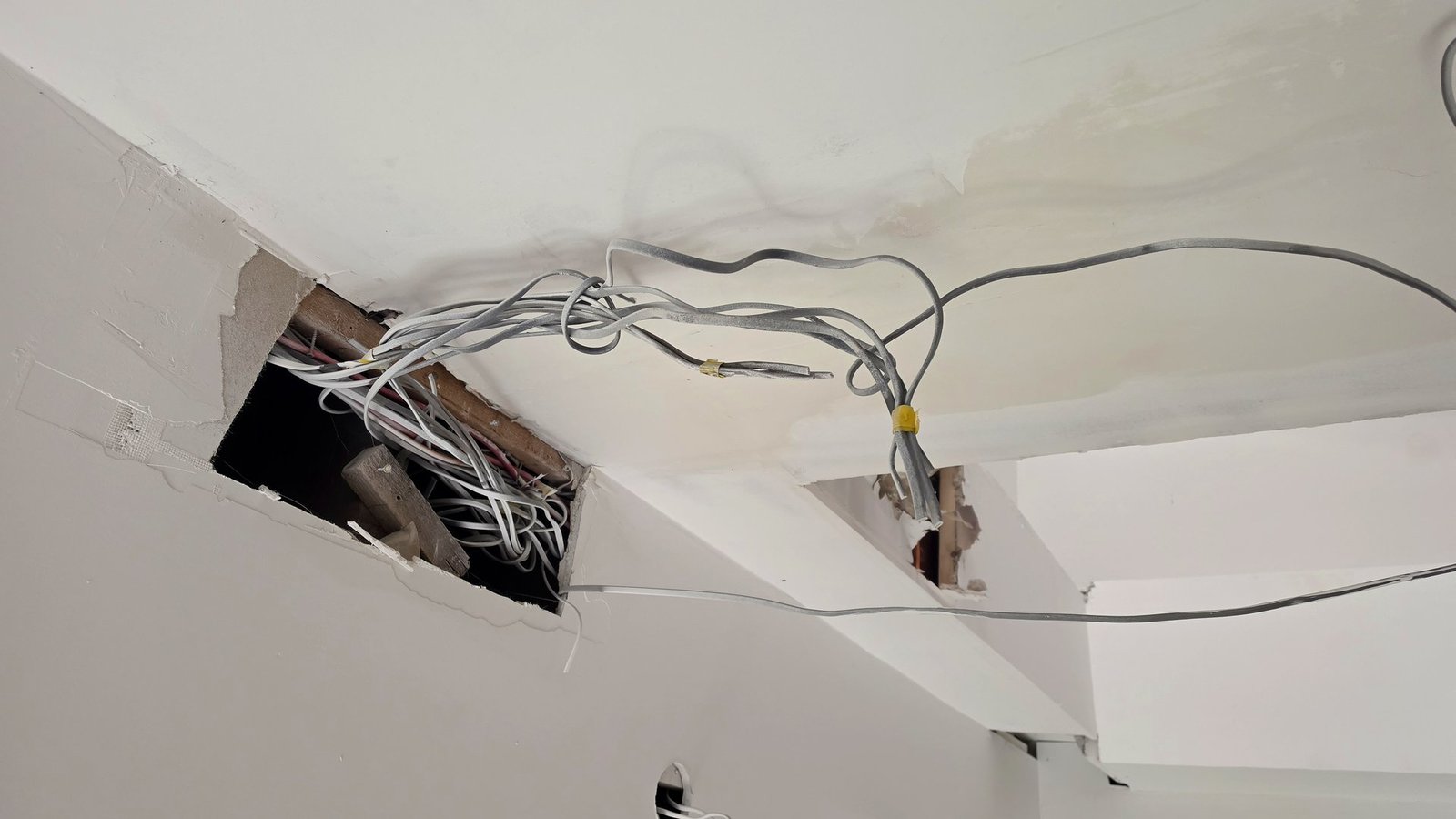
A full rewire is the complete replacement of all cables, accessories (sockets, switches, light fittings), the consumer unit, and the earthing and bonding throughout the property. Nothing from the old installation is retained except the incoming supply cable, which is the responsibility of the Distribution Network Operator.
Practically speaking, here is what a full rewire involves:
- All walls are chased to run new cables, or cables are clipped surface mounted where chasing is not possible or practical.
- First fix is completed with all new back boxes and cable routes in place.
- A new consumer unit is fitted, in Scotland this should be a full RCBO board with surge protection device (SPD) installed.
- Second fix brings all accessories back on and connects everything up.
- Full testing and certification is carried out under BS 7671, the IET Wiring Regulations.
- The property will need redecoration after the work. Walls that have been chased will need plastering or at minimum filling and painting. Factor this into your budget.
A full rewire on a typical three bedroom house takes between five and ten days depending on the size, the accessibility of cable routes, and whether the property is occupied during the work. Occupied rewires take longer because furniture needs to be moved room by room and the electricians need to leave the property habitable at the end of each day.
For a full rewire in Aberdeen or Aberdeenshire, our rewiring Aberdeen page covers what is involved in more detail.
What Drives the Decision: Understanding Your EICR
The Electrical Installation Condition Report is the document that drives almost every rewire decision. If you have had one carried out, it will contain coded observations that tell you the severity of each fault found. Understanding these codes is essential.
If you have not yet had an EICR done and you are unsure about your electrics, that is where to start. You can find out more about what is involved on our EICR Aberdeen page.
C1: Danger Present
A C1 code means there is a risk of injury from electrical shock or fire. This is not a condition to sit on. A C1 observation means the installation is unsafe right now and must be made safe before anything else. In practice, an inspector finding a C1 should make it safe at the time of inspection or advise you in writing that it must be dealt with immediately.
C2: Potentially Dangerous
A C2 code means the fault is not causing immediate danger but could become dangerous. These must be addressed. If your EICR comes back unsatisfactory, it is almost always because of C2 codes. The question for your electrician is whether those C2s are concentrated in one area or spread throughout the installation.
C3: Improvement Recommended
A C3 code means an improvement is recommended but does not make the EICR unsatisfactory on its own. These are things that fall short of current best practice but are not dangerous. You are not obliged to act on a C3, though it is usually sensible to do so over time.
How the Codes Point Toward Partial or Full
This is the key question. If C2 codes are appearing on every circuit, across every floor, covering power and lighting throughout the property, that is a systemic failure. The installation is not just old in places, it is old everywhere. A partial rewire will not resolve a systemic problem. You will fix one circuit and find the next one is just as bad. A full rewire is the only sensible approach.
If C2 codes are isolated to one circuit type, one floor, or one specific area, a targeted partial rewire may well resolve every failing observation on the report without the need to touch the circuits that tested satisfactorily.
Only a qualified inspector holding the 2391-52 inspection and testing qualification can make this determination from your specific report. The codes alone do not tell the full story. The inspector understands what they observed, what they tested, and what condition the parts of the installation they could not see are likely to be in. Their recommendation carries weight.
Property Types in Scotland Most Commonly Needing a Full Rewire
Scotland has a distinctive housing stock and some property types appear again and again as candidates for full rewires. If your property falls into any of these categories, expect the conversation to lean toward a full replacement rather than a patch job.
Pre-1960s Aberdeen Granite Terraces and Tenements
Aberdeen’s granite built properties, particularly those built before the 1960s, frequently still have their original rubber insulated wiring. Rubber insulation does not last forever. Over decades it dries out, becomes brittle, and cracks. When you disturb it during inspection it can crumble away entirely. This wiring is dangerous and no amount of targeted repair will make it safe. Every circuit in a property with original rubber wiring needs replacing.
1960s and 1970s Properties with Aluminium Wiring
During the 1960s and 1970s, aluminium was used as a substitute for copper in domestic wiring due to copper shortages. Aluminium wiring expands and contracts with temperature changes at a different rate to the accessories it connects to. Over time this causes loose connections, which create heat and risk. Properties with aluminium wiring throughout generally need a full rewire. It is not a problem that can be selectively addressed.
Properties with No Earthing on Lighting Circuits
A huge proportion of older Scottish homes were wired with two-core cable on the lighting circuits, meaning the light fittings have no earth conductor. Modern metal light fittings and bathroom lighting require an earth connection. Properties where this applies throughout the whole house are strong candidates for a full rewire, particularly if the power circuits also show their age.
Properties with Decades of Amateur Additions
Some properties have had multiple owners, each of whom added circuits, extended sockets, or modified the wiring with varying levels of competence. The result is an installation that is part original, part 1980s extension, part recent DIY, and none of it is properly documented. In these cases a full rewire is often the most cost effective approach because it resolves every uncertainty at once rather than having an electrician try to unpick what is safe and what is not across a patchwork of unknown vintage.
Property Types Where a Partial Rewire Is Often Enough
Not every older property needs a full rewire. There are plenty of situations where targeted work is the right call.
One Failed Circuit on an Otherwise Sound Installation
If a property was rewired fifteen years ago and a single circuit has developed a fault, the answer is to replace that circuit. There is no reason to disturb good wiring that is performing correctly on every test.
Kitchen or Bathroom Refits
When a kitchen is extended or a bathroom is added, new circuits are required. This is partial rewire work by definition. The existing installation is fine. Only the new or modified area requires new wiring.
Incorrect Addition That Stands Alone
If one previous owner added a garage circuit or extended the sockets in a room and did it incorrectly, but the main installation is sound, fixing that specific addition is all that is needed. The poor work does not contaminate the rest of the installation.
Lighting Circuits Without Earths, Power Circuits Sound
This is a common partial rewire scenario in Aberdeenshire. The property was rewired at some point in the past but only the power circuits were done. The lighting circuits are still the original two-core wiring with no earth. Replacing the lighting circuits across the whole property while leaving the ring finals in place is a legitimate and cost effective solution.
Rewire Costs in Scotland: 2026 Guide Prices
Cost is inevitably one of the first questions homeowners ask. The figures below are guide prices for the Aberdeen and Aberdeenshire area. Aberdeen and Aberdeenshire prices run higher than the Scottish average due to local demand, travel considerations for rural properties, and the general cost of living in the north east. These prices are guides only. Every property is different and the only accurate figure comes from a site visit and a written quote.
Full Rewire Guide Prices (Aberdeen and Aberdeenshire, 2026)
| Property Size | Guide Price (+ VAT) |
|---|---|
| 1 bedroom property | From £3,000 |
| 2 bedroom property | From £3,500 |
| 3 bedroom property | From £5,000 |
| 4 bedroom property | From £7,000 |
These prices cover all cable, accessories, a new consumer unit, full testing, and certification under BS 7671. They do not include redecoration after the work. Plastering, filling, and painting after a rewire is a separate cost that depends on how much wall chasing was needed and the condition of the existing plaster.
Partial Rewire Costs
Partial rewire costs vary enormously because the scope varies enormously. A single circuit replacement might cost a few hundred pounds. Replacing all lighting circuits across a three bedroom house could run to £1,500 or more. Rewiring one floor of a property or replacing a kitchen installation with all new dedicated circuits could reach several thousand pounds. The only way to know is to describe your specific situation to an Aberdeen electrician who can assess the property.
What is consistent is that a partial rewire will always cost less than a full rewire when the scope genuinely only covers part of the installation. If the quotes you are getting for a partial rewire are approaching full rewire territory, ask the electrician to explain why. Sometimes the answer is that they have assessed the property and concluded that a partial job is not practical or appropriate.
Can You Do a Rewire in Stages?
Yes, and this is a legitimate approach that more homeowners and landlords should know about. Phased rewiring means prioritising the most critical circuits first and completing the rest in subsequent visits over a period of months or years.
Here is how it typically works in practice:
- The inspector identifies which circuits have the most serious faults based on the EICR.
- Those circuits are replaced in the first phase.
- A new EICR is issued covering the updated installation.
- The remaining circuits are scheduled for a subsequent phase.
For landlords managing costs across a portfolio of properties, phased rewiring makes the expenditure more manageable without leaving tenants in unsafe properties. It is particularly useful for Aberdeen landlords with older stock, where a full rewire of every property at once would be prohibitively expensive.
The important point is that each phase must be certified separately. You cannot do half the work and issue one certificate at the end. Each set of circuits completed gets tested and certified at the time of completion.
What About the Consumer Unit?
The consumer unit deserves its own section because it is frequently misunderstood in the context of partial versus full rewiring decisions.
If you are having a partial rewire, you do not automatically need a new consumer unit. Provided the consumer unit is in good condition, has adequate protection for the circuits it controls, and is compliant with current requirements, it can be retained. The new circuits will be connected into the existing board.
However, if the consumer unit is an old-style rewireable fuse board, or a first-generation RCD board without individual RCBO protection on each circuit, your electrician may recommend replacing it at the same time as the partial rewire work. There is an efficiency argument for doing both at once: the consumer unit replacement disrupts the installation in any case, and combining the work saves labour.
A full rewire always includes a new consumer unit. For any full rewire we carry out in Peterhead, Aberdeen, or across Aberdeenshire, we install a full RCBO board with surge protection. Every circuit gets its own RCBO, which means if one circuit trips it does not affect the rest of the property. This is the current best practice standard and anything less is not something we would fit on a full rewire.
Sometimes the consumer unit itself is the problem. Certain older boards have a known history of failure. If the board is the issue and the wiring behind it is otherwise sound, a consumer unit upgrade in Aberdeen alone might resolve the faults on your EICR without any rewire work at all.
Does a Rewire Need a Building Warrant in Scotland?
This question comes up regularly and the answer for Scotland is yes, in most cases a full rewire requires a Building Warrant from your local authority under the Scottish Building Regulations. This is different from the system in England and Wales, where a NICEIC registered contractor self-certifies under Scottish Building Regulations of the Building Regulations. BS 7671 does not apply in Scotland.
In Scotland, electrical work on a dwelling that goes beyond minor work falls under the Building (Scotland) Act 2003. A full rewire is not minor work. Your contractor applies for the Building Warrant before the work starts and a Completion Certificate is submitted to the local authority when it is finished. This is an additional cost and adds time to the project, but it is a legal requirement and provides important protection when you come to sell the property.
For partial rewires, the position depends on the scope. Replacing a single circuit may not trigger the warrant requirement. Anything more significant almost certainly will. Your electrician should advise you on this for your specific situation.
Frequently Asked Questions
How do I know if I need a full or partial rewire?
The only way to know with certainty is to have an EICR carried out by a qualified inspector holding the 2391-52 inspection and testing qualification. The report will identify the faults and their severity. If faults are widespread across the whole installation, a full rewire is likely. If they are localised, a partial rewire may resolve them. Do not rely on a visual inspection alone. Old wiring can look fine on the outside and be crumbling inside the walls.
Can I live in my house during a rewire?
Yes, in most cases you can remain in the property during a full rewire, though it is disruptive. The electricians work room by room and restore basic power at the end of each day so you have lighting, heating, and a functioning kitchen. Occupied rewires take longer and typically cost a little more due to the additional time required to work around furniture and restore functionality daily. If the property is empty, the work is faster and usually cheaper.
Does a rewire need a Building Warrant in Scotland?
Yes. Scotland uses the Building (Scotland) Act 2003 and Scottish Building Regulations. BS 7671, which applies in England and Wales, does not apply in Scotland. A full rewire requires a Building Warrant from your local council before work starts and a Completion Certificate submitted on completion. A NICEIC Approved Contractor will handle this process on your behalf as part of the job.
How long does a full rewire take?
A one or two bedroom property typically takes three to five days. A three bedroom house takes around five to eight days. A four bedroom or larger property can take ten days or more. These are working day estimates for an unoccupied property. Add time if the property is occupied, if there are access complications, or if the property is a traditional stone built house where chasing is more demanding.
Will insurance pay for a rewire?
Generally no. Home insurance covers sudden and unexpected events such as fire damage or storm damage. It does not cover gradual deterioration of the electrical installation. The wiring in your home wearing out over decades is wear and tear, not a sudden event. Some policies include specific electrical breakdown cover as an add-on, but standard buildings insurance does not cover rewiring costs. The one exception may be where an insured event, such as a fire, has directly damaged the wiring. In that case, the repair of the damaged installation may be covered.
What certification do I get after a rewire?
After a full rewire you will receive an Electrical Installation Certificate under BS 7671, along with the Building Warrant Completion Certificate for Scotland. The Electrical Installation Certificate details every circuit, the test results, and confirms the installation conforms to the Wiring Regulations at the time of installation. Keep these documents safe. You will need them when you sell the property and your insurer may ask to see them. After a partial rewire you will receive an Electrical Installation Certificate covering the new circuits, and where applicable, an updated EICR for the installation as a whole.
Next Steps
If you are in Peterhead, Aberdeen, or anywhere across Aberdeenshire and you have had an EICR come back with faults, or you know your property is due an inspection, the place to start is a conversation with a qualified electrician. Bring your EICR if you have one. A good electrician will go through it with you, explain what the codes mean for your specific property, and give you an honest assessment of whether you are looking at partial or full rewire work.
We also cover Fraserburgh and the surrounding area. If you need an electrician in Fraserburgh, we can help with the same NICEIC Approved standard of work.
You can reach us directly on 07304 027013 or through our contact page. We are happy to discuss your EICR results and give you a no-obligation view on what the work is likely to involve before any commitment is made.
For further independent guidance on rewiring, the Electrical Safety First rewiring guidance is a reliable resource for homeowners across the UK.
About the Author
Steven Watt is the founder of Faithful Spark Electricians, based in Peterhead and serving Aberdeen and Aberdeenshire. He holds City and Guilds 2357 (Electrotechnical NVQ), 2365 (Electrical Installations), and 2391-52 (Inspection, Testing and Certification of Electrical Installations). Faithful Spark Electricians is a NICEIC Approved Contractor and an OZEV Authorised Installer for EV charge points. Steven carries out rewires, EICR inspections, consumer unit upgrades and all domestic and commercial electrical work across the north east of Scotland.