Skip to main content Skip to footer
BS 7671 Amendment 4: What It Means for Aberdeen and Aberdeenshire Homeowners in 2026
If you have spoken to an electrician recently, or done any research into electrical work for your home, you may have heard mention of BS 7671 Amendment 4. The wiring regulations have been updated, a new edition is now published, and from October 2026 it becomes the only version that matters for any new electrical installation work carried out in the UK, including Scotland. Whether you are planning a rewire, a consumer unit replacement, an EV charger, or a solar installation, this change affects the work your electrician must carry out and the standards they must certify against.
This post explains what Amendment 4 actually is, what has changed, and why it matters practically for homeowners in Aberdeen and Aberdeenshire who are planning electrical work in 2026 or beyond.
What Is BS 7671 and Why Does It Matter in Scotland?
BS 7671 is the IET Wiring Regulations, published jointly by the Institution of Engineering and Technology (IET) and the British Standards Institution (BSI). It is the national standard that governs the design, installation, inspection, and testing of all low voltage electrical installations across the UK. Every qualified electrician working on fixed electrical installations in Scotland must work to this standard.
In Scotland, BS 7671 sits beneath Standard 4.5 (Electrical Safety) of the Scottish Building Standards, which is the framework that governs all building work under the Building (Scotland) Act 2003 and Building (Scotland) Regulations 2004. Scotland does not use BS 7671. BS 7671 applies in England and Wales only. In Scotland, compliance with BS 7671 is how an electrician demonstrates compliance with Standard 4.5, and the Electrical Installation Certificate (EIC) issued at the end of any new electrical installation or alteration is the legal evidence that the work meets that standard.
When the wiring regulations change, those changes flow directly into the legal framework that governs electrical safety in Scottish homes. Amendment 4 is therefore not an optional upgrade or a a welcome extra. It is the standard that every new electrical installation and alteration must meet once the transition period closes.
What Is Amendment 4 and When Does It Apply?
Amendment 4, formally cited as BS 7671:2018+A4:2026, was published on 15 April 2026 by the IET and BSI. It is the fourth and most likely final amendment to the 18th Edition of the wiring regulations, which was originally published in 2018. The 18th Edition has been updated in stages: Amendment 1 in 2020, Amendment 2 in 2022, Amendment 3 in 2024, and now Amendment 4 in 2026.
A six month transition period runs from 15 April 2026 to 15 October 2026. During this window, installations may legally be designed and certified to either the previous version (BS 7671:2018+A3) or the new Amendment 4. From 16 October 2026, the transition period closes and all new electrical installation work must comply with Amendment 4. There is no extension and no grace period beyond that date.
Existing installations are not required to be upgraded unless they are materially altered or extended. However, any addition or alteration to an existing installation must itself comply with Amendment 4 from October 2026 onwards, and the altered circuits must be inspected and tested to the new standard.
Faithful Spark Electricians is already working to Amendment 4 standards ahead of the mandatory date. As an NICEIC Approved Contractor (registration 620239), we are required to work to the current edition of BS 7671 and are independently assessed against it annually.
What Has Actually Changed? The Key Technical Updates
Amendment 4 is the most significant update to the wiring regulations since Amendment 2 in 2022. It introduces entirely new chapters and sections, not just revisions to existing ones. Here is what has changed and what it means for the type of work that homeowners in Aberdeen and Aberdeenshire are most likely to be planning.
New Chapter: Stationary Secondary Batteries
Amendment 4 introduces a dedicated new chapter covering stationary secondary batteries, meaning fixed battery energy storage systems installed as part of a residential electrical installation. This is a direct response to the rapid growth in home battery installations, particularly those paired with solar PV systems.
Battery storage systems present risks that do not exist in a conventional installation. They can discharge fault current in both directions through the installation, which means that standard MCBs, RCDs, and RCBOs (which are designed to operate on fault current flowing in one direction) may not provide adequate protection in all fault scenarios. Amendment 4 introduces specific requirements under Regulation 530.3.201 that address this directly.
Under the new rules, where fault current can flow bidirectionally through protective devices, those devices must either be rated and tested for bidirectional operation, or the installation must be designed in a way that ensures unidirectional devices are not exposed to reverse fault current, or additional measures must be taken to ensure protection is maintained regardless of the direction of energy flow. The choice of approach must now be recorded on the Part 6 electrical certificate under the updated Regulation 133.1.3.
In practice, this means that any electrician installing a battery storage system from October 2026 must be able to demonstrate that the protective devices in the consumer unit are appropriate for a bidirectional installation. This is a significant departure from how many systems were installed in previous years and underlines why the choice of electrician for battery storage work matters considerably. Find out more about our solar panel and battery storage installations in Aberdeen.
Solar PV: Chapter 72 Rewritten
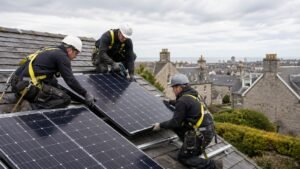
The section covering solar photovoltaic systems has been substantially rewritten as a standalone Chapter 72. The key changes for domestic installations include new requirements for rapid shutdown, updated DC cable sizing methodology, and new rules for string protection.
Rapid shutdown is a significant safety requirement introduced in Amendment 4 through the rewritten Chapter 72. Any solar PV system on a building must have a rapid shutdown system capable of reducing DC conductors to a safe voltage within a defined time of activation. This protects firefighters and emergency responders from the risk of electric shock from energised DC conductors on the roof or within the building. For most domestic installations, this means additional safety equipment at module or string level that was not required under the previous edition.
DC cable sizing for roof mounted systems must now account for an additional temperature loading of between 15 and 25 degrees above ambient, depending on how close the cables are to the roof surface. Cables that were sized adequately under the previous edition may not meet the new requirements if the same installation were being designed today. This affects how solar installations are specified and how they are inspected on an EICR.
New Section: Power over Ethernet (PoE)
Amendment 4 introduces a dedicated new section covering Power over Ethernet installations. PoE is the technology used to deliver both data and electrical power through a single Ethernet cable, and it is now a common feature of smart home installations, including networked security cameras, smart doorbells, wireless access points, and smart lighting controllers.
PoE systems are low power by nature, but the new section in Amendment 4 establishes clear requirements for how these systems must be installed and earthed within a building, including the new section on ICT functional earthing and functional equipotential bonding. In smart homes, where PoE infrastructure increasingly runs alongside or interacts with the fixed electrical installation, having a clear regulatory framework is long overdue.
For homeowners considering smart home upgrades or whole house AV and network infrastructure as part of a renovation or rewire, the presence of new PoE and ICT earthing requirements in Amendment 4 means this work benefits from being designed and installed alongside the main electrical installation rather than added later by separate contractors.
ICT Functional Earthing
Alongside the PoE section, Amendment 4 adds a new section specifically covering functional earthing and functional equipotential bonding for information and communication technology equipment and systems. This addresses how sensitive ICT equipment is earthed in a way that protects it from interference and damage from transient voltages, while ensuring that protective earth requirements under the main installation are not compromised.
In older properties or those with dated wiring, ICT earthing was rarely considered when the installation was designed. Amendment 4 brings this formally into the regulatory framework, which matters as more homes incorporate home offices, server equipment, and networked audio-visual systems.
AFDD Requirements: Arc Fault Detection Devices
Arc Fault Detection Devices, or AFDDs, have been discussed and debated in the electrical industry for several years. In earlier editions of BS 7671, AFDDs were a recommendation under Regulation 421.1.7 rather than a mandatory requirement. Amendment 4 changes that for specific installation types.
From 16 October 2026, AFDDs become mandatory for single phase AC final circuits supplying socket outlets in four specific premises types: high rise residential buildings (over 18 metres or more than six storeys), Houses in Multiple Occupation (HMOs), purpose built student accommodation, and care homes. These are the premises where arc faults present the greatest risk to life, whether through building height, shared occupancy, or the vulnerability of the people living there.
For standard single occupancy domestic houses, AFDDs remain a recommendation under Amendment 4 rather than a mandatory requirement. The amendment strongly recommends them for bedroom circuits and living room circuits in domestic properties, and a well specified new consumer unit installation should now include them as best practice, particularly on circuits serving socket outlets in bedrooms. If you are having a full consumer unit replacement carried out this year, it is worth discussing AFDD coverage with your electrician before the work begins. See our consumer unit replacement service in Aberdeen for more detail on what a properly specified installation looks like.
EV Charging: Section 722 Updated
Section 722, which covers electric vehicle charging installations, has been revised in Amendment 4. The key updates affect how charging circuits are designed for multi point installations, clarify the earthing arrangements permissible for different charger types, and update the requirements for cable management systems used with EV cables.
For domestic single charger installations, the most relevant update concerns the earthing arrangements for TN-C-S (PME) earthed supplies, which is the most common earthing arrangement in domestic properties in Scotland. Amendment 4 explicitly permits PME earthing for Mode 3 chargers where an additional earth electrode or earth mat is provided, offering clearer guidance than previous editions on what is acceptable.
The Type B RCD requirement, or the equivalent Type A RCD with 6 mA DC detection, remains in place for Mode 3 chargers under updated Regulation 722.411.4. Any EV charger installation carried out from October 2026 must be designed to meet these requirements, and the electrician must hold OZEV authorisation as well as the required BS 7671 competence. Our EV charger installation service in Aberdeen covers all of this as standard.
RCD Protection on Domestic Lighting Circuits
Regulation 411.3.4 requires 30 mA RCD protection for all AC final circuits supplying luminaires in domestic premises. The regulation uses the word “shall,” making this a firm requirement. Amendment 4 carries this requirement forward unchanged and confirms that any unprotected domestic lighting circuit will be coded C2 on an EICR from October 2026 onwards.
On a fully RCBO protected consumer unit, this is already standard practice, as each circuit has its own individual RCBO providing both overcurrent and residual current protection. But on older boards where lighting circuits run on MCBs under a shared RCD, or on any new installation that falls short of full RCBO protection, this requirement has direct implications. Any new installation or rewire must include 30 mA RCD protection on every lighting circuit.
This is one of several reasons why a full RCBO consumer unit remains the correct and only appropriate specification for any new installation or consumer unit replacement. The practice of installing a consumer unit with dual RCDs covering groups of circuits is not the correct approach for a new installation under current BS 7671 requirements.
Surge Protection Devices: Section 534 Revised
Section 534, which covers surge protection devices (SPDs), has been completely revised in Amendment 4. The most significant technical change is the introduction of updated selection requirements for the voltage protection level of SPDs, which must now be applied when specifying devices for any installation where a surge protection risk assessment indicates they are required.
Surge protection has been a more prominent feature of new electrical installations since it was elevated to a risk assessment requirement in the 18th Edition. Amendment 4 tightens the selection methodology to ensure that SPDs specified for an installation actually provide effective protection rather than meeting a nominal specification. For homeowners with significant investment in electronics, IT equipment, or smart home infrastructure, proper SPD specification under Amendment 4 provides a higher level of protection than previous editions offered.
What This Means If You Are Planning Electrical Work in Aberdeen This Year
The October 2026 mandatory date creates a practical decision point for homeowners in Aberdeen and Aberdeenshire who have been considering electrical work. Here is what you should know.
Work Carried Out Before 16 October 2026
During the transition period, electrical work may be designed and certified to either the previous edition or Amendment 4. At Faithful Spark Electricians, we are already working to Amendment 4 standards and have been since the publication date of 15 April 2026. Any work we carry out during the transition period is certified to Amendment 4, meaning the documentation you receive reflects the current standard rather than the outgoing one.
Work Carried Out from 16 October 2026
From October 2026, there is no choice. All new installation work, all additions and alterations to existing installations, and all periodic inspection and testing must be carried out to BS 7671:2018+A4:2026. If you instruct an electrician who is not up to date with Amendment 4 requirements, any EIC they issue after that date is non compliant, which means your documentation does not accurately represent the standard the work was meant to meet.
This matters for property sales, insurance, and landlord compliance in exactly the same way as any other certification issue. An EIC is only as good as the standard it certifies compliance with. Making sure your electrician is working to the right edition of BS 7671 is not a technical nicety. It is a practical necessity.
The Installations Most Affected by Amendment 4
If you are planning any of the following, Amendment 4 has direct and material implications for how the work must be designed and installed:
- A full house rewire: lighting circuits must now have individual 30 mA RCD protection, and the consumer unit specification must reflect current RCBO and AFDD best practice. See our full house rewire service in Aberdeen.
- A consumer unit replacement: the full RCBO specification remains the correct approach, and AFDD coverage on bedroom and living room circuits is now strongly recommended. See our consumer unit replacement service in Aberdeen.
- EV charger installation: Section 722 updates affect earthing arrangements and documentation requirements. See our EV charger installation service in Aberdeen.
- Solar PV and battery storage: Chapter 72 has been rewritten, with new rapid shutdown requirements and bidirectional protection requirements for battery systems. See our solar panel installation service in Aberdeen.
- EICR inspections: periodic inspection and testing of existing installations must be carried out to Amendment 4. Any defects noted on an EICR that require remedial work will need that work completed to the new standard. See our EICR inspection service in Aberdeen.
How Scottish Building Standards Interact with Amendment 4
For homeowners in Scotland, it is worth understanding exactly how Amendment 4 fits within the regulatory framework. Scotland operates under Standard 4.5 (Electrical Safety) of the Scottish Building Standards Technical Handbook, not under Scottish Building Regulations, which applies in England and Wales only. Standard 4.5 requires that electrical installations comply with BS 7671, and the IET publishes the version of BS 7671 that applies. When Amendment 4 becomes mandatory in October 2026, that is the version of BS 7671 referenced by Standard 4.5 for all new work.
The Electrical Safety First guidance on Scottish building regulations sets out how all electrical installation work in Scottish homes must comply with the Building Standards system, and how registered electricians who operate as approved certifiers can self certify that work. In practice, using an NICEIC registered electrician means the EIC they issue at the end of a job is your legal evidence of compliance with both BS 7671 and Standard 4.5.
For more detail on when electrical work in Scotland requires a building warrant, and when Schedule 3 exemptions apply, see our guide to building regulations and electrical work in Scotland.
What to Look for in an Amendment 4 Compliant Electrician
Not every electrician working in Scotland today has updated their training and working practice to reflect Amendment 4. The IET published Amendment 4 on 15 April 2026, and the qualification structure has been updated accordingly, with the previous Level 3 Award in the Requirements for Electrical Installations closing for registration on 31 July 2026. Electricians who have not undertaken Amendment 4 training are certifying work against an increasingly outdated edition of the standard.
When instructing an electrician for any new electrical installation or alteration from this point forwards, it is reasonable to confirm that they are working to BS 7671:2018+A4:2026 and that any EIC they issue will reflect compliance with Amendment 4. An NICEIC Approved Contractor is required to work to the current edition of BS 7671 and is independently assessed annually, which provides an objective basis for confidence in their compliance.
You can verify any NICEIC contractor’s registration status on the NICEIC public register. For Faithful Spark Electricians, our NICEIC registration number is 620239. Every job is personally led by Steven Watt, who began his career as a Royal Navy engineering apprentice and holds City and Guilds 2391-52 in inspection and testing. Our work is independently inspected and we carry the NICEIC Platinum Promise.
Faithful Spark Electricians: Amendment 4 Compliant, Aberdeen and Aberdeenshire
Faithful Spark Electricians is based in Peterhead and serves Aberdeen and the wider Aberdeenshire area. As an NICEIC Approved Contractor already working to BS 7671:2018+A4:2026, we are carrying out rewires, consumer unit replacements, EV charger installations, solar PV and battery storage work, and EICR inspections to the current standard ahead of the mandatory date.
Whether you are planning electrical work now or later in the year, the answer is the same: instruct an electrician who is working to Amendment 4, make sure the EIC you receive at the end reflects compliance with the current standard, and keep that documentation safe. It is the foundation on which your property’s electrical compliance rests.
For a free written quote or to discuss what Amendment 4 means for your specific project, contact our Aberdeen electrician team or call us on 07304 027013.