Skip to main content Skip to footer
Commercial EICR in Aberdeen and Aberdeenshire: What Business Owners Need to Know
If you own or manage a commercial property in Aberdeen or Aberdeenshire, you have a legal duty to keep its electrical installation safe for staff, customers, and visitors. A commercial Electrical Installation Condition Report, usually shortened to EICR, is the formal mechanism for demonstrating that duty is being met.
This guide covers what a commercial EICR actually is, how it differs from a domestic one, what your legal obligations are, and what the findings mean for your business.
What a Commercial EICR Is
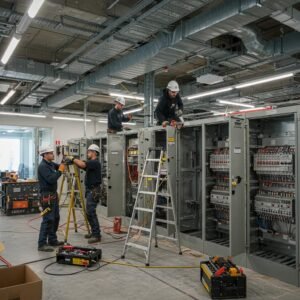
An EICR is a formal periodic inspection of every fixed electrical circuit in a property. For commercial premises, this covers every circuit, every accessory, every distribution board, and every protective device, along with any three phase supplies, sub mains, machine circuits, or process electrical equipment specific to your business.
The legal basis for this obligation sits with the Electricity at Work Regulations 1989, which places a duty on employers and duty holders to maintain electrical systems in a condition that prevents danger, so far as is reasonably practicable. An EICR is the standard, recognised way of demonstrating compliance with that duty.
For general background on what an EICR involves at a fundamental level, see our guide on what an EICR is.
How a Commercial EICR Differs From a Domestic One
The underlying testing principles are the same, but the scale and complexity are usually very different.
Scope of Circuits
A domestic EICR typically covers a single consumer unit and perhaps 10 to 15 circuits. A commercial EICR can involve multiple distribution boards, three phase supplies, sub mains feeding separate areas of a building, and specialist circuits for machinery, catering equipment, or process systems specific to the business.
Time Required
A domestic inspection is usually completed within a few hours. A commercial inspection for a small office or retail unit around 1,000 square feet typically takes a full working day. Larger industrial premises with multiple sub boards can take two to three days.
Access and Business Continuity
Commercial premises often need to remain partially or fully operational during inspection, which requires careful planning around which circuits can be isolated and when. Domestic inspections rarely face this constraint in the same way.
Specialist Equipment
Commercial premises frequently have equipment domestic properties do not, such as catering equipment, industrial machinery, server rooms, or specialist process equipment. Testing this safely requires specific knowledge of how that equipment is wired and protected.
How Often Does a Commercial EICR Need to Happen
Frequency depends on the type of premises and the level of risk involved. The recommended intervals, based on IET and industry guidance, are generally as follows.
- Offices and shops: every 5 years.
- Restaurants, kitchens, and hospitality premises: every 5 years, though insurers sometimes request shorter intervals given higher electrical loads and equipment turnover.
- Industrial premises and workshops: every 3 years, reflecting higher wear on equipment and connections.
- Construction sites: as frequently as every 3 months for temporary supplies, given the harsh and changing conditions.
- Petrol stations and other hazardous or CompEx environments: annually, due to the elevated risk profile.
- Hotels and rented commercial accommodation: every 5 years under the Repairing Standard framework, or more frequently depending on individual risk assessment.
These are recommended maximum intervals, not fixed rules that apply identically to every premises. A risk assessment specific to your business, its equipment, and its usage pattern should determine the right interval for your situation. Your insurer or landlord may also specify particular intervals as a condition of cover or lease.
What Gets Tested During a Commercial EICR
A competent inspector works through your installation systematically, checking:
- The condition and suitability of your consumer unit or distribution boards, including whether protective devices meet current standards.
- Earthing and bonding arrangements throughout the property.
- Insulation resistance on every circuit, to check for degraded cable insulation.
- Earth fault loop impedance, confirming faults will be cleared quickly enough to prevent danger.
- RCD and RCBO operation, where fitted, to confirm they trip within the required time.
- Condition of accessories, sockets, switches, and fixed equipment connections throughout the premises.
- Any visible signs of damage, overheating, or previous poor workmanship.
What C1, C2, and C3 Codes Mean for a Business
Every issue found during an EICR is classified using a standard coding system.
C1: Danger Present
This means there is a risk of injury right now. A C1 finding requires immediate action, and in a commercial setting this can mean isolating the affected circuit or area immediately, even before the rest of the inspection is complete.
C2: Potentially Dangerous
Urgent remedial action is needed, but the risk is not immediate. These findings should still be addressed promptly, and many insurers expect evidence of remediation within a defined timeframe.
C3: Improvement Recommended
These are not classed as dangerous but represent an improvement that would bring the installation closer to current standards. Addressing C3 items is good practice and often makes commercial sense ahead of a future inspection, but is not an immediate legal requirement in the same way as C1 or C2.
For a full explanation of these codes with examples of what triggers each classification, see our detailed guide on EICR C1, C2, and C3 codes explained.
Why This Matters Beyond Compliance
A satisfactory EICR is not just a legal box to tick. It reduces the risk of electrical fires and equipment failure, which protects your staff, your customers, and your business continuity. Insurers frequently ask for evidence of a current EICR when processing claims involving electrical damage, and a lapsed or unsatisfactory report can complicate or delay a claim significantly.
If your business operates from rented premises, your obligations may sit alongside, rather than instead of, your landlord’s own duties. It is worth clarifying this in your lease rather than assuming responsibility sits entirely with one party.
Cost Guide for Commercial EICR in Aberdeen and Aberdeenshire
Pricing depends heavily on the size and complexity of your premises. As a general guide:
- Small office or retail units typically start from £300 plus VAT.
- Medium sized commercial premises typically range from £600 to £1,200 plus VAT.
- Industrial premises and workshops are usually priced on survey, given the wide variation in scope.
- HMO licensed premises typically range from £300 to £500 plus VAT.
Note that EICR pricing generally starts from £150 for the smallest domestic properties, though commercial premises are priced separately given the additional scope and time involved. All figures here are starting points, and your actual price depends on the specifics of your premises, uncovered during a proper assessment or quote process.
Aberdeen and Aberdeenshire Specific Considerations
Aberdeen and Aberdeenshire have a wide mix of commercial premises, from city centre offices and retail units through to industrial workshops, agricultural buildings, and hospitality venues serving the region’s tourism trade. Older commercial buildings in Aberdeen city centre, some converted from Victorian granite properties, often have a more complex electrical history than purpose built modern units, which can affect inspection time and findings.
If you manage a commercial let or HMO, additional considerations apply. See our guide on EICR requirements for HMOs in Aberdeen for details specific to licensed rented accommodation.
Preparing Your Premises for Inspection
A little preparation before the inspector arrives makes the whole process smoother. Make sure distribution boards and consumer units are accessible, rather than blocked by stock, furniture, or equipment. Provide any existing electrical certificates or previous EICRs, since these give the inspector useful history about the installation. If any areas need to remain operational during the visit, flag this in advance so the inspection can be planned around it, rather than causing conflict on the day.
For premises with specialist equipment, such as commercial kitchens or workshops with fixed machinery, it helps to have someone available who understands how that equipment is wired, in case the inspector has questions about specific circuits.
What Happens If You Skip a Commercial EICR
Beyond the safety risk itself, skipping a scheduled EICR creates real practical exposure. If an electrical fire or fault occurs and your premises has no current EICR, an insurer may argue you failed to maintain the installation as required, potentially reducing or denying a claim. Regulatory bodies, including the Health and Safety Executive, can also take enforcement action against businesses that fail to demonstrate reasonable practicable steps to maintain electrical safety.
For licensed premises, such as HMOs or short term let accommodation, a missing or lapsed EICR can also affect your licence renewal. See our guide on EICR requirements for short term lets in Scotland if this applies to your business.
Choosing a Competent Inspector
Commercial EICRs, particularly for larger or more complex premises, require a different level of experience than a standard domestic inspection. Ask any contractor you are considering whether they regularly carry out commercial inspections, and check their NICEIC or SELECT registration explicitly covers inspection and testing work, not just installation. Our guide on why NICEIC approval matters explains the verification process, and the same principle applies to any contractor working on your commercial premises, regardless of location.
Frequently Asked Questions
Who is legally responsible for arranging a commercial EICR?
The employer or duty holder responsible for the electrical installation under the Electricity at Work Regulations 1989. In a rented property this is often clarified in the lease, but the underlying legal duty generally sits with whoever controls the electrical installation in practice.
What happens if my EICR comes back unsatisfactory?
Any C1 or C2 findings need remedial work, and depending on severity, some circuits may need immediate isolation. A satisfactory report is issued once remedial work is complete and retested.
Can I use my EICR for insurance purposes?
Yes, and many insurers specifically request a current EICR as part of policy conditions or when processing a claim. Keep your certificate on file and ensure your renewal dates do not lapse.
How is this different from a narrower guide focused just on cost and frequency?
This guide covers the full picture, including legal duties, testing scope, and coding. If you specifically want a shorter, practical breakdown focused on how often, how much, and what happens during the inspection itself, see our companion guide on commercial EICR frequencies, costs, and what is tested in Aberdeen.
How Remedial Work Is Typically Handled
Once your EICR identifies issues, remedial work follows as a distinct phase. Your contractor should provide a separate quote for this work, clearly linked to the specific codes identified in your report. C1 findings are usually addressed immediately, sometimes on the same visit if practical and safe to do so. C2 findings are typically scheduled promptly, often within a matter of weeks depending on severity and business operational constraints. C3 items can usually be scheduled at a convenient time, such as alongside other planned maintenance or refurbishment work.
After remedial work is complete, the affected circuits are retested and your EICR is updated to reflect a satisfactory outcome. Keep both the original report and any remedial documentation together as a single record, since this full history is often what insurers and regulators want to see, rather than just the final satisfactory result in isolation.
Budgeting for Commercial Electrical Compliance
Sensible budgeting treats commercial EICRs as a predictable, recurring cost rather than a surprise expense. Knowing your premises type and its recommended inspection interval lets you plan the cost into your annual or multi year budget well in advance. Setting aside a contingency for potential remedial work, particularly for older premises or those that have not been inspected for some time, avoids compliance costs catching your business off guard.
Getting Started
For commercial electrical services across Aberdeen, visit our commercial electrician Aberdeen page. You can also see our wider Aberdeenshire coverage on the areas we cover page, or get in touch through our contact page.
For official guidance on employer duties around electrical safety, see the Health and Safety Executive’s guidance on electrical safety at work and the NICEIC website for verifying contractor registration.