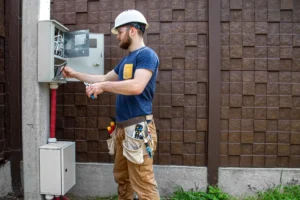
If you own or rent a flat in Aberdeen, you might assume an EICR is the same job as it is for a house. It isn’t. Flats — particularly the granite tenement blocks that make up so much of Aberdeen’s housing stock — come with a set of electrical complications that simply don’t exist in a detached or semi detached property. Shared supplies, meter cupboards in communal hallways, wiring that hasn’t been touched since the sixties, unusual metering arrangements in older blocks — all of it affects how an inspection is carried out and what the report is likely to find.
This post covers everything specific to getting an EICR Aberdeen for a flat: what makes flats more complex, what the inspection actually involves, what tends to fail, who is responsible for arranging one, and what it costs. Whether you’re a landlord, an owner occupier, or someone buying a flat, read this before you book.

What Makes Flats Different for an EICR
The short answer is that a flat rarely has a fully self contained electrical installation. There are almost always shared elements, and in Aberdeen’s older tenement stock, those shared elements have often been added to, modified, or left untouched for decades.
Shared electrical supplies and common parts
Most tenement blocks have communal lighting on the common stair, door entry systems, and sometimes shared supplies to meter rooms or plant equipment. These are not part of your individual flat’s EICR. They belong to the building’s common installation, which is the responsibility of the factor or owners association, and they require a separate inspection. What your flat’s EICR covers is the installation inside your own property, starting from the consumer unit (fuseboard) through to every socket, light fitting, and fixed appliance.
Where it gets complicated is when parts of your flat’s installation are physically located outside your flat. That’s common in Aberdeen.
Meter cupboards in communal areas
In a large number of Aberdeen tenement flats — particularly those converted or wired in the 1970s and 1980s — the consumer unit is not inside the flat. It’s in a communal meter cupboard on the landing or in a shared hallway. This matters for a few reasons. Access has to be arranged in advance. The landlord or factoring company may hold the key. In some buildings, getting to the board requires access to a locked common area that the tenant doesn’t control.
Before any EICR is carried out on an Aberdeen flat, it’s worth establishing exactly where the consumer unit is and who needs to provide access. This isn’t an obstacle — it just needs to be sorted beforehand so the inspection day doesn’t get wasted.
Old wiring in granite tenement blocks
Aberdeen’s granite tenements are some of the most solid buildings in Scotland. Unfortunately, some of them are also still carrying original or near original wiring. It’s not unusual to find rubber insulated cables from the 1960s still in service in these properties, particularly in flats that haven’t been fully refurbished. Old rubber insulation becomes brittle and cracks over time. It won’t necessarily show obvious signs of damage, but under insulation resistance testing during an EICR, it often reveals serious deterioration. That’s exactly what the inspection is designed to find.
Unusual metering arrangements
Some older Aberdeen tenement blocks have unusual metering arrangements that date back to how the building’s electricity supply was originally divided up. You occasionally find situations where one meter serves parts of two different flats, or where a supply runs through a common area before reaching the individual flat’s board. These arrangements aren’t necessarily dangerous, but they do complicate an EICR because the inspector needs to establish exactly what’s being tested and what falls outside the scope of the individual flat’s installation.
HMO conversions
Aberdeen has a significant HMO (House in Multiple Occupation) market, partly driven by the oil and gas industry and partly by the university. A property that’s been converted to an HMO often has multiple consumer units, additional circuits added at different times by different people, and layouts that weren’t designed for the way the property is now being used. HMO EICR Aberdeen inspections are more involved than a standard single let flat — there’s simply more installation to test, and HMO properties tend to have had more done to them over the years.
What Does an EICR on a Flat Actually Involve
An Electrical Installation Condition Report is a thorough inspection and test of the fixed electrical installation in the property. “Fixed” means everything that’s wired in permanently — not appliances you can unplug. Here’s what the process looks like in plain English.
Visual inspection of the consumer unit
The inspection starts at the consumer unit (the fuseboard). The electrician will open it up and check what’s inside — the type of protection fitted, the condition of the wiring, whether there are any signs of overheating, burning, or water ingress, and whether the board meets current standards. In Aberdeen flats, this is often where the most significant findings are made, because many of these boards haven’t been replaced since the property was first wired or converted.
Circuit testing
Each circuit in the flat is tested individually. The tests carried out include:
- Continuity testing — checking that the earth and protective conductors in each circuit are intact and properly connected throughout
- Insulation resistance testing — measuring the resistance of the cable insulation to confirm it hasn’t deteriorated. This is where old rubber wiring often shows its age
- Polarity testing — confirming that live and neutral conductors are correctly connected at every point in the circuit
- Earth fault loop impedance testing — verifying that in the event of a fault, sufficient current would flow to operate the protective device quickly enough
RCD testing
Where residual current devices (RCDs) are fitted, they’re tested to confirm they trip within the required time when a fault is detected. RCDs are the devices that protect against electric shock — they detect small imbalances in current flow and disconnect the circuit in milliseconds. Many older Aberdeen flat installations either have no RCD protection, or have outdated earth leakage circuit breakers (ELCBs) that don’t meet current standards.
Earth bonding checks
Supplementary and main protective bonding is checked at gas and water pipework entry points. This is particularly relevant in tenement flats where pipework is shared between properties. If there’s no bonding, or if it’s been disconnected at some point (which does happen), that’s a C2 code on the report — meaning it’s a potentially dangerous condition that needs remedial work.
Smoke alarm check
In Scotland, every home must have mains powered, interlinked smoke alarms — this has been a legal requirement since February 2022 under the Housing (Scotland) Act 2014. The EICR inspection will check whether the alarms fitted are mains powered and correctly interlinked. Battery only alarms are not compliant. This catches out a lot of Aberdeen flats that were brought up to standard but where the alarms have since been replaced with battery units.
The report itself
At the end of the inspection, you receive the EICR document. The overall result is either Satisfactory or Unsatisfactory. Individual findings within the report are coded:
- C1 — Danger present. Requires immediate action before the property can be used
- C2 — Potentially dangerous. Remedial work required but not necessarily immediate
- C3 — Improvement recommended. Not a failure, but worth addressing
- FI — Further investigation required. Something that couldn’t be fully assessed during the inspection
A satisfactory report means the installation is in an acceptable condition for continued use. An unsatisfactory result means C1 or C2 codes are present and remedial work is required.

Common Faults Found in Aberdeen Flats
Every property is different, but Aberdeen tenement flats tend to produce similar findings. These are the things that come up most regularly.
Old MEM or Crabtree consumer units with no RCD protection
MEM and Crabtree boards were common in 1970s and 1980s installations across Aberdeen. Many of them are still in service. The problem with these boards isn’t necessarily that they’re faulty — some are still mechanically sound — but that they provide no RCD protection. Under current BS 7671 standards (and we are now on Amendment 4, which becomes mandatory in October 2026), all circuits in a domestic installation should have RCD protection. A board with no RCDs at all will generate C2 codes, and depending on the specific circuits involved, potentially C1 codes.
ELCBs instead of RCDs
Earth leakage circuit breakers (ELCBs) were a precursor to modern RCDs, and they’re still found in some Aberdeen flats. ELCBs work differently to RCDs — they detect voltage on the earth conductor rather than current imbalance, and they have a known failure mode where they can become ineffective without showing any obvious sign of having done so. When an EICR tests an ELCB, it almost always fails the test. This is a C2 finding at minimum and usually triggers a recommendation to replace the board entirely.
Missing earth bonding
Main protective bonding to gas and water services is a basic requirement of BS 7671, and it’s missing from a significant number of Aberdeen flats. In tenement properties, the pipework enters the building through communal areas and then branches off into individual flats — sometimes the bonding was never installed properly, and sometimes it’s been removed during bathroom or kitchen refurbishment and not reinstated. Missing bonding is a C2 code.
Old red and black wiring with no earth conductor
Two core wiring (live and neutral only, no earth) is found in some of the older Aberdeen tenement flats. This is typically rubber insulated wiring from before the 1960s. The absence of an earth conductor on lighting circuits was once standard practice; it is not acceptable now. Old wiring with no earth is coded as C2, and depending on condition, may be C1 if the insulation has deteriorated significantly.
No SPD (surge protection device)
Surge protection devices weren’t a standard requirement until relatively recently, but under BS 7671 Amendment 4, SPD provision is now expected in domestic installations. Many Aberdeen flats have never had an SPD fitted. This typically appears as a C3 (recommendation) rather than a failure, but it’s something to be aware of if you’re planning any remedial work after the EICR, because it’s sensible to include an SPD at the same time as any consumer unit upgrade.
Unsafe DIY wiring
In converted tenement flats and HMO properties, it’s not unusual to find additions to the wiring that have been done without proper materials, proper installation methods, or any certification. Extension leads used as permanent wiring, sockets added to circuits they shouldn’t be on, lighting circuits extended in the wrong cable — all of these show up during an EICR. Depending on the severity, these can range from C2 to C1.
Who Needs an EICR for a Flat in Aberdeen
Private landlords
If you’re a private landlord in Scotland, an EICR is not optional. Under the Scottish Government Repairing Standard guidance and the Repairing Standard, landlords are required to ensure the electrical installation is inspected and tested at intervals of no more than five years. You need a valid EICR before you let the property, and you need to renew it every five years during the tenancy. This applies to every private rented flat in Aberdeen and Aberdeenshire. For more detail on the legal requirements, see our page on landlord EICR Scotland.
HMO landlords
HMO licensing in Scotland requires a valid EICR as a condition of the licence. Aberdeen City Council will not grant or renew an HMO licence without one. The inspection requirements for HMO properties are the same as for standard private rented accommodation, but the properties tend to be more complex and the inspection takes longer as a result.
Owner occupiers buying a flat
If you’re buying a flat in Aberdeen — particularly an older tenement flat — an EICR before purchase is one of the most sensible things you can do. A home report will give you a surveyor’s view of the property, but surveyors aren’t electricians. They won’t test the circuits or open the board. An EICR will tell you exactly what condition the electrical installation is in before you commit. Mortgage lenders are increasingly asking for electrical reports on older properties, so having one ready can also smooth the purchase process.
Sellers
Scottish solicitors and surveyors are increasingly raising questions about the electrical installation during property transactions, particularly in older flats. Having a current EICR available when you’re selling removes one potential complication and gives buyers confidence. If the installation is in good order, an EICR is a straightforward thing to provide. If it isn’t, it’s better to know before it becomes a problem during a sale.
Factor managed blocks and owner occupiers
In a factor managed block, the responsibility for the common areas — communal lighting, door entry systems, any shared electrical supplies — sits with the factor or the owners association. The individual flat owner is responsible for the electrical installation within their own property. If you’re an owner occupier in a tenement block, your EICR covers your flat. The factor handles the rest. If you’re unsure about the split of responsibilities in your building, ask the factor directly before booking an inspection.
What About the Communal Areas
This is one of the most common points of confusion with tenement flats in Aberdeen, so it’s worth being clear about it.
The communal stair lighting, the door entry system, any electrical supply to a shared meter room, communal heating systems — none of this is included in your flat’s EICR. These common parts form a separate electrical installation. They need their own inspection, and the responsibility for arranging and paying for that inspection lies with whoever manages the common parts — typically the factor or the owners association.
If you’re a landlord and your factor has never arranged an inspection of the common parts, that’s worth raising with them. If something goes wrong on the common stair due to a defective electrical installation, the liability question becomes complicated. A factor doing their job properly should have a regular inspection regime in place for the common parts.
For your individual flat EICR, the inspector starts at your consumer unit and tests your circuits. The communal installation is a separate job and a separate report.

How Much Does an EICR Cost for a Flat in Aberdeen
Faithful Spark Electricians carry out EICRs on flats from £150 + VAT. That’s the starting price for a straightforward flat with a manageable consumer unit, accessible circuits, and no particular complications.
The actual price for your property will depend on a few things:
- Size of the flat — a one bedroom flat with a small number of circuits is a quicker job than a three or four bedroom property with more to test
- Age of the wiring — older properties with rubber insulated cables or complex wiring arrangements take longer to inspect properly
- Number of circuits — more circuits means more testing time
- Access — if the consumer unit is in a communal cupboard and access needs to be arranged, or if circuits are difficult to isolate cleanly, that adds time
- HMO properties — multiple consumer units and more complex layouts mean a longer inspection
Aberdeen and Aberdeenshire prices are higher than the Scottish average — labour costs in this part of Scotland reflect the local cost of living and the skills market, particularly given the area’s oil and gas industry background. If you’re seeing prices significantly below £150 + VAT for a flat EICR in Aberdeen, it’s worth asking how thorough the inspection is going to be. An EICR done in 45 minutes is not a proper EICR.
How Long Does an EICR Take in a Flat
For a standard two bedroom Aberdeen flat with a reasonably modern consumer unit and no significant access complications, allow two to three hours. A one bedroom flat might be closer to two hours. A larger property, or one with old wiring that needs more careful testing, can run to four hours or more.
You will receive your EICR certificate on the same day the inspection is carried out. The report is issued digitally and covers the full schedule of circuit test results, the condition of the consumer unit, any codes found, and the overall satisfactory or unsatisfactory verdict. There’s no waiting a week for the certificate to come back from an office.
What Happens If the EICR Comes Back Unsatisfactory
An unsatisfactory result is not the end of the world. It means C1 or C2 codes have been found — conditions that are either immediately dangerous or potentially dangerous. Remedial work is required to bring the installation up to standard.
In many cases, the issues found can be addressed quickly. Missing bonding conductors, for example, can often be sorted on the same visit if the materials are on the van. Consumer unit replacements are typically a day’s work. More complex rewiring takes longer, but the scale of the job depends entirely on what’s found.
For a full explanation of the process after an unsatisfactory result — what the codes mean, what work is required, timescales, and landlord obligations — see our page on what happens if your EICR comes back unsatisfactory.
One thing worth knowing: if you’re a landlord and your EICR comes back unsatisfactory, you have 21 days (or less if the tenant requests it in writing) to complete remedial work and provide a new satisfactory report to the tenant. That’s the legal requirement under the Repairing Standard. Don’t sit on an unsatisfactory report — it creates liability.
If you’re concerned about whether your tenant is obliged to let you carry out the inspection in the first place, that’s covered on our page about can a tenant refuse an EICR in Scotland.
About the Author
Steven Watt is a NICEIC Approved Contractor (enrolment 620239) and holds the City & Guilds 2391-52 inspection and testing qualification — the industry standard for carrying out EICRs in Scotland. Faithful Spark Electricians carry out EICRs across Aberdeen and Aberdeenshire including tenement flats, HMO properties, and private rental accommodation. Call 07304 027013 or visit EICR Aberdeen
Related: electricians in Aberdeen