
If Intelligent Octopus Go is draining your home battery, your EV may be using stored energy you intended to save for the house. UK homeowners, including those in Scotland and North East Scotland, can encounter this when their battery responds to the charger as another household load.
The solution is to stop the battery responding to the car’s demand. On a suitable installation, an electrician can separate the EV supply and position the battery’s control CT so it excludes the car, while the charger’s load management still monitors the complete incoming supply. Alternatively, a supported battery control can prevent discharge during the session. Both approaches aim to preserve the energy you wanted to use later.
Octopus acknowledges this interaction in its home battery troubleshooting guidance. Its charging instructions tell the EV when to charge; a typical separate inverter decides how to respond to the resulting load. [1]
Why is Intelligent Octopus Go draining your home battery
Picture an evening with little solar generation. Your home battery has enough energy left for cooking, lighting and the television. Octopus starts an eligible cheap EV charging slot, and the battery app suddenly shows a much higher discharge rate.
The inverter may be working exactly as configured. In self consumption mode, it tries to cover the demand measured by its CT or energy meter. If that measurement includes the charger, the car looks like another appliance asking for electricity. Indra describes this problem in its own battery compatibility guidance. [2]
You wanted the car to use cheap grid electricity and the battery to cover the house later. Instead, stored energy goes into the car and you may have to buy more expensive electricity for household use afterwards. That is the lost benefit the installation needs to address.
A worked example of the energy flow
Assume no solar generation, a car drawing 7.4 kW and household appliances using 0.6 kW. Total demand is 8 kW. If the inverter supplies 3 kW from the battery, the grid supplies the remaining 5 kW.
Over two hours at those steady powers, the inverter delivers 6 kWh from storage. If it had supplied only the 0.6 kW household load, it would have delivered 1.2 kWh. The additional demand associated with EV charging has therefore used 4.8 kWh that could have remained available for later.
These are illustrative AC power figures, not a prediction for every installation. Actual battery depletion includes conversion losses and depends on its reserve, capacity, discharge limit and changing household demand.
A cheap EV rate means less if the battery pays for the charge
Take an illustrative cheap rate of 6.2p per kWh and a later import rate of 30p. Using 4.8 kWh of stored energy in the car avoids only 29.76p of cheap imports. Keeping that same usable energy for household demand later could avoid £1.44. The difference is about £1.14 in this example.
The 6.2p and 30p figures illustrate the calculation; they are not a claim about the current tariff available to every customer. Use the rates on your own account. The comparison assumes you need the energy later and cannot replace it beforehand cheaply. Solar generation, conversion losses and export opportunities can change the result.
Why flexible Octopus charging exposes the problem
For accounts on Octopus’s updated arrangement, the home’s overnight off peak period is separate from the car’s smart charging allowance. The home has its 23:30 to 05:30 window. Eligible EV smart charging has an allowance of up to six hours per day, measured midday to midday, which can include other times. Qualifying additional charging half hours also receive the home off peak rate. [3]
A battery timer set only for overnight charging may miss an afternoon or evening EV session. Octopus’s 2026 Streams guidance encourages leaving the car connected so it can use flexible opportunities, and specifically explains why this can consume stored household energy. [4]
This is an existing equipment interaction that flexible charging can make more noticeable. It does not mean every battery installation has developed a new fault.
Check whether the updated rules have reached your account, as well as the actual session and your tariff terms. Boost charging and charging beyond the allowance have different billing treatment. Octopus’s Charge Cap, where available, addresses the EV allowance; it does not directly control an independent battery inverter. [3]
Using this guidance in Scotland and the wider UK
Before applying the tariff examples to your home, confirm that Intelligent Octopus Go is available for your postcode and compatible with your car or charger. Octopus provides an eligibility check and local rates. Use your own account prices when comparing costs in Scotland or elsewhere in the UK. [14]
The CT clamp solution explained
A current transformer, usually called a CT clamp, measures current in a conductor. Combined with the inverter’s other measurements, it helps the system determine electricity flow and decide how much to charge or discharge.
The useful question is not simply whether a CT exists. It is which circuits lie within the measurement used to control the battery.
myenergi’s published arrangement places the EV charger on a separate supply branch after the meter. The inverter’s CT measures the house branch after the split, while the charger’s grid CT remains before the split. This means the inverter’s household measurement excludes the charger. [5]
In normal self consumption operation, the battery can then respond to the house without chasing the EV load. Indra also describes excluding the charger from the battery CT measurement, with a separate EV consumer unit supplied from the main supply. [2]
What the line diagram shows
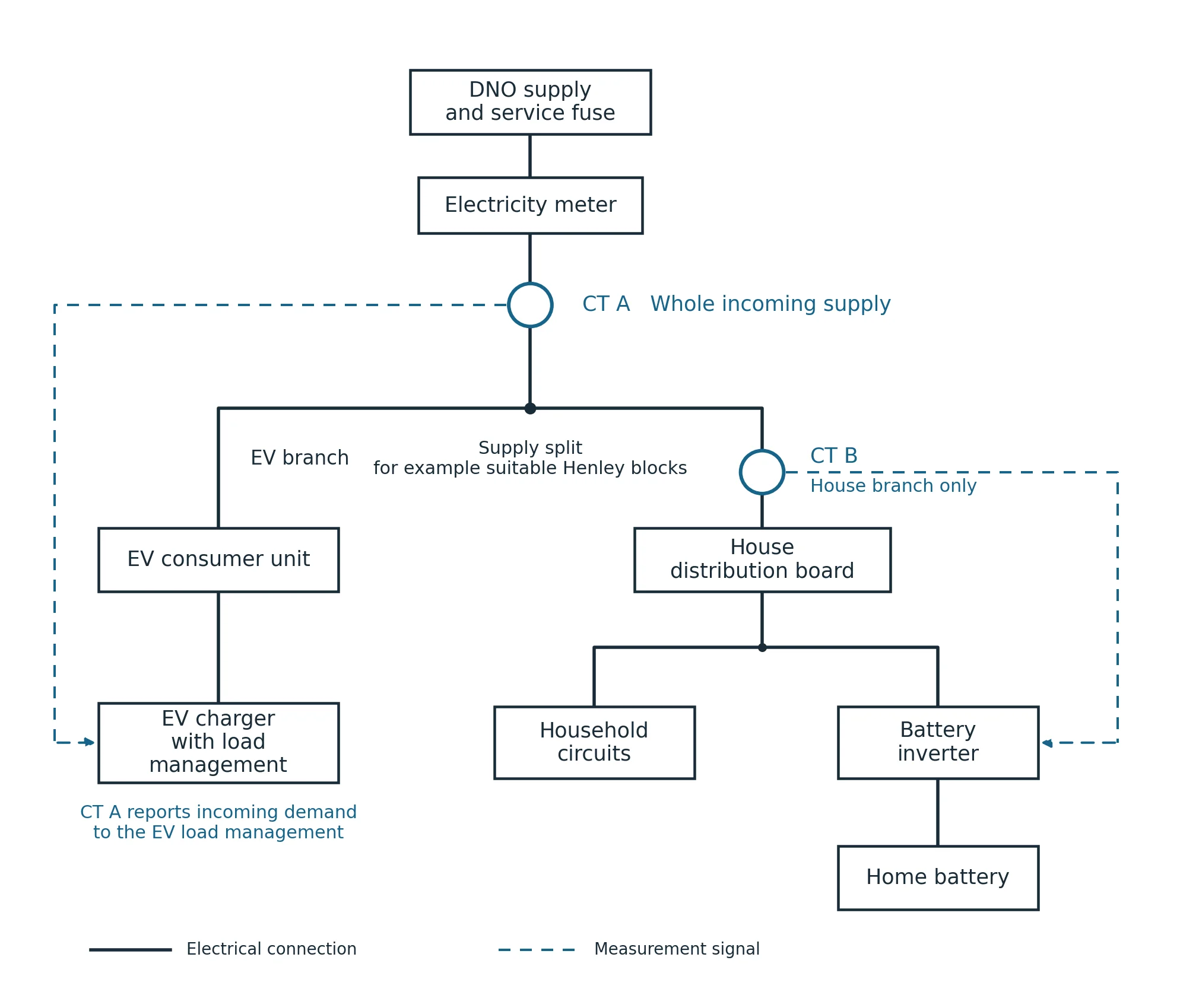
The EV branch and house branch share the same metered supply. The battery inverter and household circuits are downstream of the battery control measurement. CT A measures the whole supply for EV load management; CT B provides the inverter’s house branch measurement.
This is a single phase concept drawing. It omits neutral, earth, protective devices, isolation details and backup switching. The installer must select the actual equipment and connections for the site and manufacturers’ requirements.
What Henley blocks do
Suitable distribution connector blocks, often called Henley blocks, can provide the supply split. They do not decide which source powers the car. The useful change is the relationship between the supply branches and the inverter’s measurement. myenergi illustrates that distinction in its wiring guidance. [5]
Some homes already have a suitable separate EV supply. Others need distribution changes before the battery measurement can exclude the charger. Moving a clamp while leaving both loads on the same measured branch will not achieve the intended separation.
It changes control rather than physically blocking electricity
There is still an electrical connection between the branches. If the battery is commanded to export, its energy can flow towards the EV as well as the grid. A CT arrangement cannot create a one way barrier.
That is why the promised outcome should be specific: prevent the inverter’s normal self consumption response to EV demand. Forced discharge, export schedules and backup operation need separate consideration.
What stops the incoming supply exceeding 100 amps
Excluding the car from the battery measurement does not limit total grid import. When the car and home battery both charge, they add demand alongside the rest of the property.
Dynamic EV load management uses an appropriate measurement of the incoming supply and reduces charging when other loads need the available capacity. For a Zappi, myenergi explains that the grid CT is essential to its Grid Limit function. The battery CT and EV grid CT therefore have different jobs. [6]
The service fuse is an overcurrent protective device, not a controller that continuously adjusts the car’s charging rate. Its rating also does not establish the rating of every downstream cable, isolator or consumer unit.
A 100 A supply with an illustrative 90 A control threshold
The table assumes no solar output or battery discharge. The 90 A threshold is an example chosen to show the arithmetic, not a recommended setting for every 100 A property.
| House demand | Battery charging | EV current allowed | Total import |
|---|---|---|---|
| 30 A | 20 A | 32 A | 82 A |
| 60 A | 20 A | 10 A | 90 A |
| 85 A | 20 A | 0 A | 105 A |
The final row matters. Even with the car stopped, the other loads exceed the example threshold. EV load management cannot remove current being drawn by appliances or an independently controlled battery charger. That situation needs additional demand control, a different design or a supply review.
Charging may pause when the available current is below the vehicle’s minimum charging requirement. After changes, the electrician should verify the actual response to rising load and any loss of the measurement signal. Zappi’s manual describes both Grid Limit operation and its wired CT detection function. [7]
The IET also highlights the need to assess consumer unit capacity when solar and battery sources are added. Monitoring grid import alone does not establish that every internal part of the installation is adequately rated. [8]
Choosing between wiring changes and battery settings
The best fix should fit your existing equipment and the way you want to use stored energy. This comparison helps you ask for a specific result.
| Approach | Useful when | What to check |
|---|---|---|
| Exclude EV demand from battery measurement | You want the battery to keep supporting the house while ignoring EV demand | Compatible supply layout, inverter controls, export and backup functions |
| Scheduled no discharge or hold mode | EV sessions happen within a known window | Coverage of the entire session, including after the battery becomes full |
| Supported control following smart sessions | You want the battery to respond to changing cheap periods | Integration reliability, tariff compatibility and behaviour if communication fails |
| Supplier managed battery service | Your compatible battery is enrolled in that service | Intended battery schedule, service terms and coordination with EV charging |
These are options to assess, rather than settings that can be applied identically to every inverter. Record the current configuration before making an authorised change so the result can be compared.
Can I stop discharge in the battery app
Ohme advises owners to configure their batteries to avoid discharge during car charging, including a hold charge schedule where supported. That can be a practical solution when the inverter provides the necessary controls. [9]
However, asking a battery to charge at the same time as the car is not enough information on its own. Ask what happens after the battery reaches its target: does it continue holding its energy, or return to supplying measured loads? Check that behaviour while the EV is still charging.
A higher reserve can limit how far the battery falls, but it may still allow substantial discharge above that reserve. A fixed timer can also miss flexible sessions. Ask for the operating behaviour you want, rather than relying on a setting name that may mean something different on another brand.
Can automation follow the Octopus slots
A supported integration may be able to pause battery discharge or request battery charging during eligible EV sessions. The practical questions are whether it follows schedule changes promptly and what happens if the internet connection or control service fails.
Keep Octopus’s EV charging control requirements in mind. myenergi warns that third party control which overrides Zappi charging behaviour can conflict with Intelligent Octopus Go. Coordinating a battery requires checking the supported approach rather than repeatedly overriding the EV schedule. [10]
A battery that ignores the car can still discharge into the house
This distinction is easy to miss. If the house is using 600 W during a cheap EV slot, a battery configured to ignore only the car may still supply those 600 W.
Over two hours, that represents 1.2 kWh delivered to household circuits. The EV problem is resolved, yet the battery has still fallen because it is doing its normal household job.
If your aim is to preserve all available stored energy during cheap periods, ask about a supported hold or no discharge mode for the whole slot. The CT solution alone does not make the inverter aware of electricity prices.
This is also why “my battery must remain at exactly the same percentage” is not always a sensible acceptance test. Agree whether the target is to exclude the car only, hold stored energy for the whole property, or actively recharge the battery.
What changes with solar panels and hybrid inverters
Solar generation adds a further decision: whether to use available generation in the house, store it, supply the EV or export it. The most useful choice depends on your tariff and what the equipment can control.
A hybrid inverter combines solar and battery functions. A charger observing its combined AC output cannot necessarily identify how much came directly from the panels and how much came from storage. myenergi’s hybrid guidance explains why solar charging modes and battery controls need coordination. [11]
Why a solar avoid drain setting may not solve smart charging
myenergi describes using an export margin to help avoid battery drain during normal ECO+ solar charging. The same guidance warns that scheduled boost charging can still use battery energy unless the battery is prevented from discharging or is also charging. [11]
That makes the charging mode part of the diagnosis. A setting that works while following surplus sunshine is not proof that the battery will be preserved during a scheduled grid charge.
For Intelligent Octopus Go, check the current supplier instructions before combining independent solar diversion and smart charging. Octopus currently advises exporting surplus rather than using solar divert settings for this tariff. That is tariff specific guidance, not a universal rule for every solar household. [3]
Our solar and EV charging guide covers the wider system choices. The question here is narrower: which control should stop unwanted battery discharge during your actual charging session?
What if you have Octopus Charge Pack
Charge Pack is a separate battery service. Octopus can schedule charging and discharging of enrolled compatible batteries, including activity intended to support the grid. That is different from an independent inverter reacting automatically to the EV load. [12]
Octopus says Charge Pack and Intelligent Octopus Go share a platform, but also acknowledges that particular equipment combinations can interact unexpectedly. Its guidance asks customers to report issues such as the battery failing to charge when the EV is connected. [12]
If you use Charge Pack, check the battery’s scheduled activity and contact Octopus about unexplained behaviour before changing measurement positions. Tell your electrician about the service so a physical alteration does not undermine the intended control arrangement.
How to confirm your EV is triggering battery discharge
Use the apps without opening any electrical equipment. Compare readings from the same period, allowing for the fact that different apps may update at different speeds.
-
Before charging, note household use, battery discharge, solar generation and grid import.
-
When the scheduled EV charge begins, note the charger’s power and any sustained change in battery output.
-
Compare the readings again after the session stops, while other household loads are similar.
-
Save screenshots showing the times, rather than only the battery percentage.
For example, a sustained rise from 0.5 kW of battery discharge to 3 kW when EV charging begins gives the installer a useful lead. It is not conclusive if the oven, shower or another large load started at the same time.
After a measurement change, the inverter app may no longer include the EV in its household consumption figure. That can be consistent with the intended design. The supplier’s smart meter remains the billing measurement; excluding the EV from the inverter’s control measurement does not make its grid electricity unmetered.
What to ask your electrician to check
Give the installer your charger, inverter and battery model names, the tariff, and any supplier or third party battery control service. Mention a backup supply or multiple consumer units at the outset.
Ask for these four outcomes to be checked:
-
Battery behaviour: establish which demand the inverter measures and demonstrate that the chosen control prevents unwanted EV related discharge.
-
Supply management: confirm the incoming supply measurement includes all relevant branches and the EV reduces or pauses appropriately when capacity is needed.
-
Other system functions: check solar operation, export limits, backup arrangements and any manufacturer requirements affected by the change.
-
Handover: record the final configuration, explain what the app readings now mean and show how the system behaves after the battery reaches its charge target.
A three phase installation or a property with a battery gateway needs its own design. Do not apply a single phase drawing without checking phase measurements, distribution and backup operation.
CT clamps near meter tails or inside distribution equipment are not a homeowner adjustment. Use a competent electrician with the equipment instructions and suitable isolation arrangements. There is no reason to open a live enclosure to gather the app screenshots described above.
Common questions about an EV charger draining a home battery
Does this mean I need a new charger or battery
Not necessarily. Start by establishing the cause. A compatible setting or measurement change may achieve your goal with existing equipment. A charger that operates normally can still be part of a system whose battery controls need coordination.
Does moving the CT guarantee no battery energy reaches the car
No. It can stop the normal demand following response on a suitable system. Forced battery export, other discharge instructions and backup operation are separate conditions. The branches remain electrically connected.
Can I use Intelligent Octopus Go without solar panels
The same issue can occur with a battery that charges from the grid. Solar panels are not necessary for an inverter to respond to measured EV demand. Tell the installer how your battery charges and when you want it to supply the home.
Will this work with FoxESS, Sunsynk and other inverters
Assess the exact model and installation, not the brand name alone. Inverters, gateways and metering arrangements differ. Ask your installer to identify the supported method for your particular combination rather than copy another owner’s settings.
Should I turn off Octopus smart charging
Do not treat that as a permanent blanket fix. Intelligent Octopus Go depends on an active supported integration and its terms include charging control requirements. Resolve the battery interaction through an approach compatible with your tariff, or discuss a different tariff with the supplier. [13]
How much does the CT clamp solution cost
The price depends on access, existing supply branches, the inverter’s measurement system and any distribution work required. A settings adjustment and a new supply arrangement are different jobs. Ask for a quotation covering the diagnosis, necessary changes, testing and handover.
EV charger and home battery help in North East Scotland
For help in North East Scotland, send Faithful Spark Electricians your equipment model names, postcode and screenshots showing when the battery discharges. We can assess the arrangement and explain the suitable options before agreeing the work.
We provide EV charger installation in Aberdeen and serve Peterhead, Ellon, Mintlaw, Balmedie, Fraserburgh and Westhill, with coverage across Aberdeenshire and North East Scotland. Contact us or call 07304 027013 to discuss getting your charger and battery working together.


