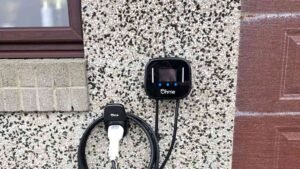
Yes, and not just any electrician. Installing a home EV charger involves your consumer unit, your earthing system, your property’s main supply fuse, and a notification to the network operator that supplies electricity to your street. Get any one of those wrong and you are looking at a fire risk, a voided home insurance policy, and a charger that could damage your car’s battery as well as the property.
The question feels simple. The answer has several layers to it, and understanding those layers is worth your time before you commit to an installation. This guide covers why a standard electrician is not always enough, what happens to your OZEV grant application if the installer is not authorised, what BS 7671 Section 722 actually requires, and what the specific considerations are for homes in Aberdeen and Aberdeenshire.
Short version: yes, you need a qualified electrician. Longer version: read on.
SCOTLAND SPECIFIC: This guide is written for Scottish homeowners. England uses Scottish Building Standards (Building (Scotland) Act 2003) for electrical work requiring an Electrical Installation Certificate. Scotland operates under the Building (Scotland) Regulations 2004 and Scottish Scottish Building Standards. The technical requirements under BS 7671 are identical across the UK, the administrative framework for certifying the work differs.
Why You Cannot Install an EV Charger Yourself
People successfully install their own outdoor lighting, change consumer unit MCBs, and add sockets to existing circuits. None of that compares to ev charger installation in terms of technical complexity, and the consequences of getting it wrong are in a different category entirely.
A 7kW home charger is a 32 amp continuous load. “Continuous” is the key word. Unlike a kettle or a washing machine, an EV charger can run at full load for six, eight, ten hours straight. The wiring from your consumer unit to the charger, the MCB or RCBO protecting that circuit, the cable sizing, the earthing arrangement, and the way the charger handles a fault all have to be engineered for that sustained load, not just sized for peak demand.
BS 7671:2018 Section 722 sets out the specific requirements for EV charging installations. This is a specialist section of the wiring regulations that most domestic electricians have never worked with. It covers:
-
Earthing arrangements, specifically the rules around PME (Protective Multiple Earthing) supplies, which is how the majority of homes in the UK are connected to the grid
-
RCD protection, EV chargers can produce DC fault currents that a standard Type A RCD cannot detect, requiring either a Type B RCD or a Type A/F RCD combined with a Residual DC Detecting Device (RDC DD)
-
Dedicated circuit requirements and load management provisions
-
IP rating and outdoor protection requirements for the charge point unit itself
-
Smart charging compliance, UK regulations require all new home EV chargers to be smart enabled, with internet connectivity and the ability to respond to grid signals
An electrician installing a charger without specific EV charging training and the right qualifications is not working to Section 722, they are guessing. That is not a risk worth taking with a 32 amp continuous load connected to the supply feeding your house.
THE EARTHING ISSUE: PME earthing, which most UK homes have, cannot simply be used to earth an EV charger without additional protection measures. The vehicle chassis creates a specific shock risk that does not exist with other appliances. Section 722 exists precisely because of this. It is one of the reasons why EV charger installation Aberdeenation is a specialist competency, not a standard electrical job.

What the Electrician Actually Needs to Know
The minimum baseline for any electrician doing EV charger installations is a current 18th Edition qualification (City & Guilds 2382) covering BS 7671 in full. But that alone is not enough. Section 722 is specialist territory, the earthing rules, the RCD type requirements, the PME limitations, and the smart charging provisions require specific training beyond the core wiring regulations.
The recognised qualification for EV charger installation in the UK is City & Guilds 2921-34, the Level 3 Award in the Installation of Electric Vehicle Charging Equipment. This covers the design, installation, and commissioning of EV charging equipment to BS 7671 Section 722 requirements. An electrician holding 2921-34 alongside their core Level 3 qualification and 18th Edition has the specific competence to install a home charger correctly.
Beyond the qualification, NICEIC registration matters here in a specific way, specifically for the Building Warrant process in Scotland. Where a Building Warrant is required (flats at any height, houses of 3 storeys or above), the homeowner must apply for the warrant through the local authority. However, NICEIC operates the Approved Certifier of Construction scheme, approved by the Scottish Government’s Building Standards Division. An electrician registered under that scheme issues a Certificate of Construction on completion, which the local authority accepts as full evidence of compliance, they do not scrutinise the technical work at all, they only verify that the NICEIC electrician was registered on the date of signing. Without that NICEIC certification, the local authority carries out its own inspections during and after the work, which adds time and uncertainty to the process.
From October 2026, The EAS Competency Change
NICEIC’s updated Electrotechnical Assessment Specification (EAS), coming into effect October 2026, tightens the competency requirements for EV charging installations specifically. Individual electricians personally carrying out EV charger installs will need to demonstrate:
-
A recognised Level 3 qualification in electrotechnical installation
-
Specific EV charging competency, City & Guilds 2921-34 or equivalent
-
At least two years of documented experience in that category of work
The era of a firm sending any available electrician to fit a charger is ending for NICEIC registered contractors. It is worth asking the person who quotes for your installation what qualification they personally hold for EV charging work.
The OZEV Grant, What It Is and Why It Matters for Installer Choice
The Office for Zero Emission Vehicles (OZEV) administers the UK government’s EV chargepoint grant schemes. As of 1 April 2026, the grant picture changed significantly. The OZEV homeowner grant for houses with driveways closed. The schemes now available to individuals are: up to £500 for flat owners who own and live in a flat with private off street parking; up to £500 for renters in any residential property with private off street parking; and up to £500 for anyone, owner or renter, with only on street parking installing a cross pavement charging solution such as a charging gully. If you own a house with a driveway in Aberdeen or Aberdeenshire, the direct homeowner grant is no longer available. Landlord grants remain open at up to £500 per socket for private landlords installing chargers for tenants.
The grant cannot be claimed by just any electrician. GOV.UK states it directly: “You need to be an OZEV authorised installer to claim the OZEV electric vehicle (EV) chargepoint grants.” The installer, not the homeowner, submits the grant claim. The funds go to the installer, and the amount is deducted from your invoice. If your installer is not OZEV authorised, the grant simply cannot be claimed. There is no workaround.
To become OZEV authorised, an installer needs to be a member of an approved competent person scheme, such as NICEIC, and hold the relevant EV charging qualification. The authorisation is not a separate bureaucratic step for its own sake. It exists because the government needs confidence that grant funded installations meet the technical standards required. It is the installer’s qualification and scheme membership that provides that assurance.
Current OZEV grant schemes are funded until 31 March 2027, following an extension from April 2026 that also increased the maximum grant from £350 to £500 per socket. The application must be made, and approved, before the installation takes place. You cannot have the charger fitted and then apply retrospectively.
GRANT TIMING: OZEV grant approval must come before installation, not after. If you want to claim the grant, your OZEV authorised installer applies first, you receive eligibility confirmation, and then, and only then, the installation proceeds. An installer who fits the charger first and asks about the grant afterwards has already disqualified you from claiming.
The DNO Notification, What It Is and Why It Cannot Be Skipped
Your Distribution Network Operator (DNO) is the company responsible for the electricity cables and infrastructure that bring power to your street and your property. In Aberdeen and Aberdeenshire, that is SP Energy Networks (ScottishPower’s network division).
Before an EV charger can be installed, the DNO needs to be notified. The reason is straightforward: a 7kW charger drawing 32 amps for several hours is a significant new load on the local network. Your DNO needs to assess whether your property’s supply and the local grid infrastructure can safely accommodate it. In most cases the answer is yes and the process is administrative. In some cases, particularly properties with older supplies, loop supplies shared with a neighbouring property, or 60 amp or 80 amp main fuses rather than the standard 100 amp, the DNO may need to carry out infrastructure work before the charger can go in.
Your installer handles the DNO notification using the Energy Networks Association (ENA) application process. In the majority of straightforward installations, a 100 amp supply, standard grid connection, detached or semi detached house with its own service, the notification can be submitted and the installation can proceed, with the DNO acknowledging within 28 days. For more complex situations, the installer submits in advance and waits for approval before proceeding.
A homeowner cannot submit the ENA application themselves in any meaningful way. It requires knowledge of the property’s maximum demand calculation, the supply characteristics, and the technical details of the charger being installed. It is not a form you fill in online. This is another reason why the installation has to be handled by someone with the specific technical background, it is not just about connecting the charger to a circuit.
The Scotland Specific Framework
Because most content about EV charger installation online is written for England, Scottish homeowners encounter guidance that does not quite apply. The administrative framework is different here, even though the technical requirements under BS 7671 are the same.
Scottish Building Standards and the 2013 Reporting Requirement
In Scotland, whether an EV charger installation requires formal Building Standards involvement depends on the type of property, not on an automatic reporting rule. Unlike England and Wales, which introduced a blanket reporting requirement for new circuits in 2013, Scotland operates on a Building Warrant framework under Schedule 3 of the Building (Scotland) Regulations 2004. The warrant requirement depends on the building type, as detailed below.
Regardless of whether a warrant is required, all EV charger installations must be carried out to BS 7671 and certified by the installer. An NICEIC Approved Contractor issues an electrical installation certificate (EIC) on completion. If a Building Warrant is required, the EIC forms part of the compliance evidence submitted to Building Standards.
Building Warrant, When Does It Apply?
The Building Warrant position for EV chargers in Scotland is confirmed by LABSS guidance INFOP25, which treats EV charger installations as “new power socket outlet” work under Schedule 3 of the Building (Scotland) Regulations 2004. The rules are straightforward:
-
House up to 2 storeys, no Building Warrant required
-
House of 3 storeys or above, Building Warrant required
-
Flat or maisonette, Building Warrant required, regardless of which floor you are on or how many storeys the building has
That last point is the one that catches people out. If you live in a ground floor flat in a two storey Aberdeen tenement, you still need a Building Warrant for the EV charger circuit, the house exemption does not apply to flats at any height. An NICEIC registered installer will identify this at the survey stage and handle the warrant application before any work starts.
New Builds in Scotland from June 2023
From 5 June 2023, the Building (Scotland) Regulations 2004 were amended to require EV charging infrastructure in new residential buildings with associated parking. Every new dwelling with a parking space must have at least one EV charge point socket with a minimum 7kW output. If you are buying a new build in Aberdeen or Aberdeenshire with associated parking, an EV ready charge point should already be part of the specification. If the developer has installed ducting but not the charge point itself, an NICEIC registered electrician can complete the installation to the regulatory standard.
SCOTLAND VS ENGLAND: England uses Scottish Building Standards (Building (Scotland) Act 2003) for electrical work requiring an Electrical Installation Certificate including EV charger installation. Scotland uses the Building Warrant framework under the Building (Scotland) Regulations 2004, a completely different system. The 2013 automatic reporting requirement for new circuits applies in England and Wales only. In Scotland, whether a Building Warrant is needed depends on building type, not the type of electrical work. The technical standard, BS 7671 Section 722, is identical across the UK. Any installer quoting for a Scottish job and citing BS 7671 does not understand the Scottish framework.
Aberdeen and Aberdeenshire, What to Know Before You Book
The age and character of Aberdeen’s housing stock creates specific considerations for EV charger installations that do not apply to newer properties.

Older Properties and Supply Capacity
Pre war granite properties in Aberdeen, tenements, terraces, and Victorian villas, often have older electrical supplies. The question of whether SSEN involvement is needed before installation is determined not by the fuse rating alone but by the total calculated demand after the charger is added. Under SSEN’s EV connection process: if total demand will be 60A or below, the installer uses Connect and Notify, no pre approval, just a notification to SSEN after installation. If total demand will exceed 60A, a full ENA application must go to SSEN and approval received before any work starts. The installer works this out at survey stage by calculating the existing household load plus the 32A charger draw, and that assessment can often begin from a remote EV charger survey. One important detail: many properties that appear to have a 100A cutout actually have a 60A or 80A fuse inside it, the fuse rating can only be confirmed on site at survey. In some cases where the supply genuinely cannot support the additional load, SSEN may need to carry out infrastructure work, that is SSEN’s responsibility, not the electrician’s, and it adds time to the project. A good installer identifies all of this upfront rather than on installation day.
Older Consumer Units
Many Aberdeen properties still have consumer units that were installed before the current standards, units without RCBOs on every circuit, without surge protection, or with limited space for a new dedicated EV charging circuit. An EV charger installation may require a consumer unit upgrade alongside it. This is not unusual and it is not a problem, but it affects the cost and the timeline. The combination of a consumer unit replacement Aberdeen and an EV charger installation by an NICEIC registered electrician is a common package for Aberdeen homeowners in older properties.
Tenement Flats and Shared Supplies
EV charger installation in an Aberdeen tenement flat is more complex than in a house. The supply may be shared, the parking arrangements are often communal, and the title conditions may require common agreement before any work is carried out on shared infrastructure. OZEV grant eligibility for flats is also on a separate application pathway. If you live in a tenement and want a home charger, start the conversation with an NICEIC registered installer early, the planning required is more involved, and it is worth understanding the full picture before committing.
What the Installation Actually Involves, From Survey to Switch On
| Stage | What Happens | Who Does It |
| 1. Survey | Electrician assesses consumer unit capacity, supply fuse size, cable routes, earthing arrangements, and optimal charger location | Your installer |
| 2. DNO check | Installer checks whether DNO pre approval is needed based on supply details and charger load | Your installer |
| 3. OZEV application (if applicable) | Installer submits grant application on your behalf. You confirm eligibility. Must be approved before installation starts | Installer + homeowner |
| 4. DNO notification/application | Installer submits ENA application. For standard 100A supplies this is often notification only; for smaller supplies, formal approval may be needed first | Your installer |
| 5. Installation day | New dedicated circuit from consumer unit, cable routed to charger location, charger unit mounted and connected, earthing arrangements verified, smart charging configured | Your installer |
| 6. Testing and commissioning | Full testing to BS 7671 Section 722, charger commissioned and tested, smart app connected, operation verified | Your installer |
| 7. Certification | Electrical Installation Certificate issued. Where a Building Warrant was required, the NICEIC Certificate of Construction is submitted to the local authority as evidence of compliance, no local authority technical inspection required. | Your installer (NICEIC) |
| 8. OZEV claim (if applicable) | Installer submits grant claim with photos and invoice. Grant deducted from your invoice | Your installer |
What Does a Home EV Charger Installation Cost in Aberdeen?
At Faithful Spark Electricians, a standard 7kW home EV charger installation in Aberdeen and Aberdeenshire typically costs £900 to £1,300 + VAT, depending on the property, the charger model, cable run length, and whether any consumer unit work is required alongside it. That price includes the survey, the DNO notification, the installation, testing, commissioning, and the Electrical Installation Certificate.
Where a consumer unit upgrade is needed at the same time, that adds to the overall cost, but there are efficiency gains from combining both jobs in one visit. The total cost of a combined consumer unit and EV charger installation is less than doing them separately.
Charger models vary. We are approved installers for Ohme, Myenergi Zappi, Andersen EV, and ICS, four of the leading home charger brands on the market. The Ohme Home Pro integrates directly with energy tariffs, adjusting charging to the cheapest available rate automatically. The Zappi is the charger of choice if you have solar panel installation Aberdeens or are planning to add them, it can be configured to prioritise excess solar generation over grid electricity. The Andersen A2 is a premium option for homeowners who want a design led unit that doubles as street furniture. ICS chargers offer a reliable, cost effective option for straightforward home charging. If solar is on your agenda in the next few years, it is worth factoring charger compatibility into the decision now.
SOLAR + EV: If you have solar panels or are planning to install them, the choice of EV charger matters. The Myenergi Zappi and certain other smart chargers can be configured to prioritise charging from excess solar generation, meaning you charge your car from your own roof rather than paying grid rates. This is worth discussing with your installer before you select a charger model.
How to Choose the Right Installer
The EV charger installation market has grown fast, and not everyone offering the service has the background to do it properly. Three things to check before you commit:
-
niceic approved Contractor or SELECT member, independently verified, audited annually, and able to self certify the work. Check any NICEIC contractor at niceic.com.
-
OZEV authorised installer, if you want to claim the grant, this is non negotiable. Ask directly: are you registered as an OZEV authorised installer?
-
City & Guilds 2921-34 or equivalent EV charging qualification, held personally by the electrician attending, not by a colleague. From October 2026 this becomes a specific NICEIC EAS requirement.
A rough quote without a survey is a red flag. The cable run, supply capacity, earthing method, consumer unit condition, and charger model all affect the price and the technical approach. Any installer pricing without seeing the property is guessing. An installer who surveys first, explains what they found, and gives you a written quote covering exactly what is included, that is the person you want connecting a 32 amp continuous load to your home.
Common Questions
| Question | Answer |
| Can I install an EV charger myself? | No. EV charger installation requires a new dedicated circuit, specialist earthing knowledge under BS 7671 Section 722, DNO notification, and certified sign off. It is not DIY work. |
| Does any qualified electrician do? | Not ideally. You want one with specific EV charging training (C&G 2921-34), NICEIC registration, and OZEV authorisation if you are claiming a grant. |
| Do I need planning permission in Scotland? | Usually no, wall mounted chargers at domestic properties benefit from permitted development rights under Scottish planning law, subject to limitations for listed buildings and conservation areas. |
| Does Scotland need BS 7671 compliance? | No. BS 7671 is England only. Scotland uses the Building Warrant framework under the Building (Scotland) Regulations 2004. Whether a warrant is needed depends on building type, for houses up to 2 storeys, no warrant is required. For flats at any height, or houses of 3 storeys and above, a warrant is required. Your NICEIC installer issues a Certificate of Construction which satisfies the local authority compliance check without requiring a technical inspection. |
| What if my flat is in a tenement? | More complex, shared supply, communal parking, and title conditions all need to be considered. Start the conversation early with an NICEIC installer experienced in tenement installations. |
| How long does an installation take? | Most standard house installations take 3 to 5 hours on the day. Pre approvals from the DNO or OZEV grant processing add time before that, allow 2 to 4 weeks from initial enquiry to installation day. |
| What charger should I get? | Depends on your situation. The Ohme Home Pro and Zappi are popular choices. If you have or plan solar, the Zappi’s solar charging capability is worth the premium. Your installer can advise based on your setup. |
| What is the OZEV grant worth in 2026? | Up to £500 per socket, available until 31 March 2027. Applies to flats and renters currently, the homeowner grant for houses closed in April 2026. Ask your installer what you are eligible for. |
| Will my home insurance cover the charger? | If installed by a qualified electrician with certification, yes, it forms part of your fixed electrical installation. If self installed or uncertified, no. Check your policy and keep the EIC. |
| Can I charge any EV from a home charger? | All modern EVs and plug in hybrids sold in the UK use a Type 2 connector as standard for AC charging. Your 7kW home charger will work with all of them. |
About the Author
Written by Steven Watt, founder of Faithful Spark Electricians, NICEIC Approved Contractor and OZEV authorised installer based in Aberdeen and Aberdeenshire. Steven holds City & Guilds 2357 NVQ Level 3 Diploma in Installing Electrotechnical Systems, City & Guilds 2365 Level 3 Diploma in Electrical Installations, City & Guilds 2382 (18th Edition Wiring Regulations), City & Guilds 2391-52 (Inspection and Testing of Electrical Installations), and an HNC in Engineering Systems. AICO Expert Installer. Approved installer for Ohme, Myenergi Zappi, Andersen EV, and ICS. Faithful Spark Electricians installs EV chargers, EICRs, consumer units, and solar connections areas we cover, Peterhead, and the wider Aberdeenshire area.
Sources
• IET, BS 7671:2018 Section 722 EV Charging Installations
• GOV.UK, OZEV EV Chargepoint Grants
• GOV.UK, EV Chargepoint Grant Guidance for Installers
• Brodies LLP, EV Charging: New Scottish Building Regulations
• Scottish Government, Building Regulations: EV Charging Infrastructure
• LABSS Information Paper INFOP25, EV Charging Points and Building Warrants
• NICEIC, EAS Changes: What Your Business Needs to Know
• Electricity at Work Regulations 1989
Book an EV Charger Installation in Aberdeen or Aberdeenshire
Faithful Spark Electricians is NICEIC Approved and OZEV authorised for EV charger installations across Aberdeen, Peterhead, and the wider Aberdeenshire area. 7kW smart charger installations from £900 + VAT. Approved installer for Ohme, Myenergi Zappi, Andersen EV, and ICS. All work certified and compliant with BS 7671 Section 722. Call 07304 027013 or visit faithfulsparkelectricians.co.uk.