
Last updated 7 October 2026
The electrical problems that come up most in Fraserburgh homes are the same as anywhere else, with two local twists: salt air off the North Sea corrodes outside electrics faster, and much of the town’s housing is either solid granite or post war stock with original wiring. You can safely check a few things yourself, such as which breaker has tripped or whether one appliance is to blame. Anything behind a faceplate, inside the board or outdoors needs an electrician.
This guide goes through each problem, what usually causes it, what is safe for you to do and when to stop and call someone. Fraserburgh is in Aberdeenshire, so any building warrant comes from Aberdeenshire Council.
Quick guide: what you can check and what needs an electrician
| Problem | Safe for you to do | Needs an electrician |
|---|---|---|
| Dead socket or circuit | Check the consumer unit for a tripped breaker or RCD and reset it once | If it trips again, or nothing has tripped |
| RCD keeps tripping | Unplug appliances and reconnect them one at a time | If it trips with everything unplugged |
| Scorched, cracked or warm socket | Stop using it and switch that circuit off | Always |
| Corroded outdoor socket or light | Stop using it and switch the outdoor circuit off | Always |
| Lights flicker in one room | Change the bulb with the power off; check it suits any dimmer | If a new, compatible bulb still flickers |
| Lights flicker or dim across the house | Ask neighbours if theirs are doing the same | If it is only your home, or it keeps happening |
| No power at all | Check the main switch; check whether neighbours are off too; report a power cut on 105 | If the supply is on in the street but not in your home |
| Burning smell, buzzing or a shock | Switch off at the main switch if it is safe to reach; call 999 if there is smoke or fire | Always, the same day |
Dead, damaged or overheating sockets
A socket that does nothing, cuts in and out, sparks when you pull a plug, feels warm or shows brown marks is one of the commonest faults in any home. The usual causes are a loose terminal behind the faceplate, a damaged socket front, or a plug or adaptor that has been overloaded. In older properties the cable behind the socket may also be tired.
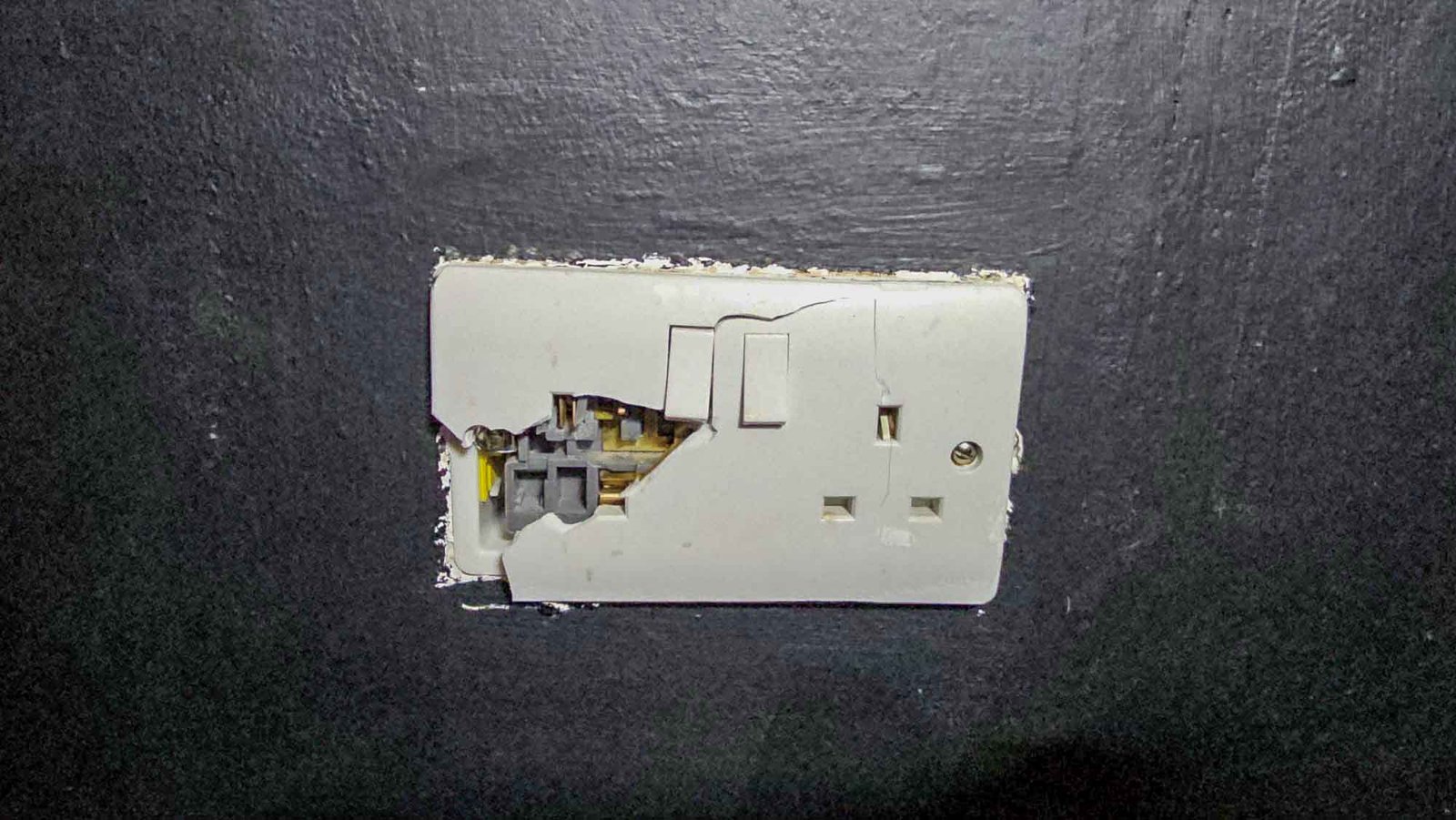
What to do: stop using it, switch that circuit off at the consumer unit, and do not open the faceplate. A single socket repair is normally a short job at our hourly rate of £55 to £75 per hour + VAT. Several warm or marked sockets around the house suggest a wider wiring problem that should be tested.
RCD tripping and damp
An RCD switches off when current leaks to earth. Two common local triggers are damp getting into an outdoor fitting, shed or garage supply, and a faulty appliance with a heating element or motor. Trips that come in wet or windy weather and then stop for days point to water getting in somewhere outside.
What to do: reset the RCD once. If it trips again, unplug everything on that side of the board and reconnect items one at a time. If one appliance trips it every time, you have found the fault. If it trips with everything unplugged, the fault is in the fixed wiring or something wired in, such as a shower, cooker or outdoor light, and it needs testing. For a fuller list of trip patterns and causes, see our guide on why a circuit breaker keeps tripping.
Salt air and outdoor electrics
Fraserburgh takes its weather straight off the sea. Salt air attacks outside electrics much faster than cable inside a dry wall, and meter boxes, outdoor sockets, isolators, cable glands and outside lights are usually the first to corrode. Corrosion in an outdoor fitting lets water in, which is a common cause of RCD trips and, left alone, a shock risk.
- Look for white or green deposits, rust streaks, cracked lids and seals that no longer close.
- Do not use an outdoor socket with a damaged cover, especially with a lawnmower or pressure washer.
- When outdoor fittings are replaced, they should be rated for outdoor use and suited to an exposed site.
An outdoor fitting that has corroded is normally replaced rather than cleaned up. If the problem is the cable or a buried supply to a shed or garage, that needs testing to find.
Flickering or dimming lights
One flickering light is usually the lamp itself, a loose fitting, or an LED bulb that does not suit the dimmer switch. Flickering across the whole house, or lights dimming when a heavy appliance starts, points to a loose connection at the board or meter, or to the incoming supply.
If neighbours see it too, it is likely to be the network rather than your wiring. SSEN runs the electricity network across the north of Scotland. Ofgem advises reporting supply problems to your local network operator, or calling 105, which is free and puts you through to the right one. If only your home is affected, have the installation checked.
Old fuse boards and protective devices
An old fuse board with rewireable fuses, or an early board with no RCD, is not automatically unsafe, but it gives less protection than a modern one and is harder to live with when something trips. Breakers and RCDs can also wear and start tripping below their rating. An electrician can test the device before anything is replaced.
- Replacing a single RCBO costs £25 to £30 + VAT per device with us, plus the time to fit it.
- A full consumer unit upgrade in Fraserburgh is £550 to £950 + VAT, depending on the number of circuits.
- Under BS 7671:2018+A4:2026, a board with two RCDs splitting the circuits can still comply. Individual RCBOs are not a legal requirement, but they mean one fault switches off one circuit rather than half the house.
Power surges
A surge protection device (SPD) fitted at the consumer unit helps protect electronics from voltage spikes, for example from lightning affecting the network or large loads switching. For an existing house it is a choice rather than an obligation: in a single dwelling the owner can decline an SPD and the electrician records that decision. Fitting one costs £40 to £80 + VAT per device with us, and it is easiest to add when the board is being changed anyway.
Old or damaged wiring
Fraserburgh has a mix of solid granite houses and post war homes, including former council houses from the 1960s and 1970s in areas such as Kirkton and Broadsea. Those are where original fuse boards, lighting circuits with no earth conductor and early PVC cable that has gone hard tend to turn up. Rubber or lead sheathed cable, where it survives, points to a rewire.

The way to find out is an Electrical Installation Condition Report. Under BS 7671:2018+A4:2026, only C1 and C2 codes make the report unsatisfactory; C3 and FI are advisory, although an FI should still be looked into promptly. Electrical Safety First recommends an EICR at least every 10 years for an owner occupied home. Ours start from £150 + VAT; see our EICR in Fraserburgh page for what the inspection covers.
Burning smell: what to do straight away
- If you see smoke or flames, get everyone out and call 999.
- If there is no fire, switch off at the main switch on the consumer unit if you can reach it safely.
- Do not open sockets, switches or the board to look for the cause.
- Leave the power off and call an electrician. Do not switch back on until the cause has been found.
Why not fix it yourself?
Mains electricity can kill, and a wrong repair can hide a fault while creating a new one. National guides often say DIY work must meet Part P or be notified to Building Control. Those are England and Wales rules and do not apply in Scotland. Here, the work must still meet BS 7671, some work (such as rewiring a flat) needs a building warrant from Aberdeenshire Council, and the person doing it should test it and issue a certificate. An uncertified repair can also cause problems with insurers and when you sell.
If you rent in Fraserburgh
Report electrical faults to your landlord or letting agent. Under section 13 of the Housing (Scotland) Act 2006, the Repairing Standard requires the installations for the supply of electricity to be in a reasonable state of repair and in proper working order, and your landlord needs an EICR at least every five years. In a flat, your own wiring and consumer unit belong to the owner or landlord, while the stair lighting and shared supply are a matter for all the owners in the building.
Frequently asked questions
What should I check first when something electrical stops working?
Go to the consumer unit and see whether a breaker or RCD has switched off. Reset it once. If it goes off again, or nothing has tripped and the street has power, leave it off and call an electrician.
Why do my lights flicker during storms?
Weather can affect the supply network, causing brief dips that show up as flicker. If neighbours see the same thing, report it to the network operator on 105. If it happens in calm weather too, or only in your home, have your wiring checked.
Can I replace a socket myself in Scotland?
Part P does not apply in Scotland, but any work must still meet BS 7671 and should be tested. If you are not able to test and certify the work, use an electrician. A broken or scorched socket is a sign of a fault, not just a cosmetic problem.
How do I know if my wiring is safe?
Look for scorch marks, warm sockets, crackling and unexplained trips, then have an EICR carried out. It tests every circuit it can reach and tells you whether anything is dangerous.
How much does it cost to find an electrical fault?
Our fault finding is £80 to £150 + VAT for the first hour, then £55 to £75 per hour + VAT. Any repair is quoted before we start it.
Do coastal homes need different electrical fittings?
Outdoor fittings on an exposed coastal property take more punishment, so they should be rated for outdoor use and checked for corrosion. Indoor wiring is the same as anywhere else.
Need a fault found in Fraserburgh?
We look after Fraserburgh and AB43 from our base at 17 Thomson Road, Peterhead. Read more on our electrician in Fraserburgh page, or how electrical fault finding in Aberdeenshire works. Faithful Spark Electricians is a NICEIC Approved Contractor (620239). Call 07304 027013 (Mon to Fri 8am to 6pm, Sat 9am to 1pm) or use our contact page.


