Skip to main content Skip to footer
EICR in Aberdeen: A Plain English Guide for Homeowners and Landlords
Aberdeen has one of the most varied property markets in the north east, from Victorian granite tenements in the West End to 1960s tower blocks, new build estates on the city fringe, and a large private rental and HMO sector serving students and workers. All of that variety means Electrical Installation Condition Reports, or EICRs, throw up quite different results depending on where in the city your property sits. This guide explains what an EICR is, why Aberdeen’s housing stock matters, what it costs, and how to read your results once they arrive.
This article is written to inform, not to sell you anything. If you decide you need an inspection after reading, our EICR Aberdeen service page has current pricing and availability across the city.
What an EICR is and what it checks
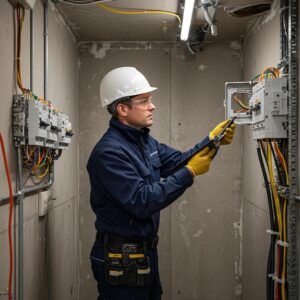
An EICR is a formal inspection of a property’s fixed electrical installation. That means the consumer unit, the cabling within walls and floors, sockets, switches, lighting circuits, and the earthing and bonding arrangements. It does not cover portable appliances such as kettles or lamps, which fall under a separate process called PAT testing.
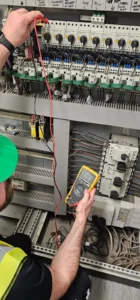
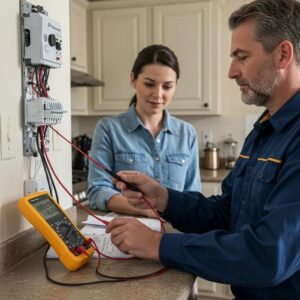
A qualified inspector tests every circuit with calibrated equipment and checks the installation against the current wiring regulations, BS 7671. The property is then given an overall result of Satisfactory or Unsatisfactory, with any issues recorded under a standard coding system. You may also hear it called a periodic inspection, a fixed wire test, or a landlord safety certificate. All of these describe the same document.
Why Aberdeen’s housing stock produces such varied results
Granite tenements and West End flats
Aberdeen’s granite tenement stock, much of it built between the late Victorian period and the 1930s, is some of the oldest housing in the city. Wiring has usually been through at least one, and often several, rewire cycles by now, but shared closes and communal supplies can complicate earthing arrangements. Missing main bonding is a frequent finding, particularly where a gas or water main was upgraded without the electrical earthing being brought into line at the same time.
1960s and 1970s estates
Areas built in this period, common across the city’s outer suburbs, often still have original or once updated consumer units. A significant number of these lack RCD protection across every circuit, which under the current Repairing Standard is now a requirement for any rented property.
New build developments
Newer estates on the city fringe generally have modern consumer units already fitted with full RCD or RCBO protection, and EICRs on genuinely new properties tend to come back clean. Even so, a second hand purchase within a new estate is worth inspecting independently, since previous owners occasionally add sockets or garden lighting without proper certification.
HMO and student rental stock
Aberdeen has a substantial HMO market, driven by its universities and its history as an oil and gas centre. HMO properties face additional scrutiny and, in many cases, more frequent inspection cycles tied to licence renewal, on top of the standard five year EICR requirement. Higher occupancy levels also place more demand on circuits, so overloaded sockets and extension lead misuse are common findings.
The legal position in Scotland
Under the Housing (Scotland) Act 2006, every private landlord in Scotland has a duty to ensure a satisfactory EICR is in place for each rented property, renewed at least every five years. This sits within the Repairing Standard, the minimum condition standard for private rented housing in Scotland. Aberdeen City Council can request a copy of a landlord’s EICR at any time and can pursue enforcement through the First Tier Tribunal if one cannot be produced. The underlying statutory duty is set out in Section 19A of the Housing (Scotland) Act 2006, and the Scottish Government’s practical guidance sits within the Repairing Standard statutory guidance on gov.scot.
Since March 2024, the Repairing Standard has required RCD protection on every circuit in a rented property. This has caught out a lot of Aberdeen’s older tenement and estate stock, where boards were previously considered acceptable with partial coverage. Our guide to the Housing (Scotland) Act 2006 and electrical safety explains the legislation in more depth, and EICR requirements for landlords in Scotland covers the practical side of staying compliant.
Homeowners are not legally required to have an EICR, but a standard Home Report does not include electrical testing, so buying an older Aberdeen property without one leaves you with no independent evidence of the wiring’s condition. Our guide on getting an EICR before buying a house in Scotland covers this specific scenario in more detail.
What happens during the inspection
A typical three bedroom Aberdeen property takes between two and four hours to inspect. The inspector needs access to the consumer unit and to every room, since accessories are checked individually. Larger HMO properties or flats with multiple lets naturally take longer given the number of circuits involved.
The core tests carried out are:
- A visual check of every accessory, the consumer unit, and visible cabling.
- Insulation resistance testing to check cable insulation has not degraded.
- Continuity testing on protective conductors to confirm the earthing path is intact.
- Polarity checks confirming live, neutral, and earth are correctly wired at every accessory.
- Earth fault loop impedance testing to confirm faults clear quickly enough to prevent injury.
- RCD testing at multiple trip currents and times.
Expect brief interruptions to the power supply, circuit by circuit, during testing. It is worth telling tenants in advance if the property is occupied, particularly in HMO settings with several households.
Understanding the coding system
Every observation on an EICR carries a code that tells you how urgently it needs addressing.
- C1, Danger present. An immediate risk to safety, such as exposed live conductors. This must be made safe right away.
- C2, Potentially dangerous. Not immediately dangerous, but could become so under fault conditions, such as a circuit with no RCD protection. Rented properties must have these fixed within 28 days under the Repairing Standard.
- C3, Improvement recommended. Not dangerous, but below current best practice. An older but functioning fuse board is a typical example. This does not fail the report on its own.
- FI, Further investigation required. Something could not be fully assessed during the visit and needs follow up before the report can be finalised.
An EICR is Satisfactory when there are no outstanding C1, C2, or FI codes. Our detailed guide on EICR C1, C2, and C3 codes explained covers examples of each in far more depth.
Common findings across Aberdeen
The pattern of findings varies by property type, but the most frequent issues we see across the city include:
- Missing or partial RCD protection, particularly in tenement and 1960s to 1970s estate stock.
- Missing main bonding in older flats where gas or water supplies were updated without matching earthing work.
- Overloaded circuits and extension lead misuse in HMO and student properties.
- Old rewirable fuse boards that still function but no longer meet current guidance.
- Damaged or scorched accessories from years of heavy use in high occupancy lets.
- Bathroom zone violations where sockets or switches sit too close to a bath or shower.
For a broader regional view, see our article on the most common electrical issues found during EICRs.
What an Unsatisfactory result means
An Unsatisfactory result is common, especially in Aberdeen’s older stock, and it does not automatically mean a property is unsafe to occupy unless a C1 has been identified. The report lists exactly what needs fixing. Landlords have 28 days under the Repairing Standard to resolve C1 and C2 items, after which a retest confirms the work and updates the certificate.
Where the root cause is a consumer unit lacking full RCD coverage, replacing the board is usually the most sensible long term fix rather than adding protection circuit by circuit. Amendment 4 of BS 7671, mandatory from October 2026, sets full RCBO protection on every circuit as the expected standard, moving away from split load arrangements where only some circuits sit behind an RCD. Our guide to consumer unit upgrades with full RCBO protection explains what this involves, and NICEIC’s own guidance on Electrical Installation Condition Reports is a useful independent reference.
What an EICR costs in Aberdeen
Pricing depends on property size and the number of circuits to test. As a general guide, EICRs in Aberdeen start from £150 for a one bedroom flat, rising with property size. HMO EICRs and landlord portfolio inspections are quoted separately given the additional scope. Every price quoted is a starting price for a straightforward job, not a fixed fee, and a written quote should always be confirmed before work begins. Our EICR cost guide for Aberdeenshire breaks pricing down further, and the EICR Aberdeen service page has current local pricing.
Landlords: staying on top of the five year cycle
Tracking renewal dates across a portfolio is the most common practical challenge for Aberdeen landlords. Set a reminder well ahead of the five year deadline rather than letting it lapse, since a lapsed EICR leaves you unable to demonstrate compliance if the council asks. If you manage several properties, most inspectors will group them into the same visit at a discounted rate with a single invoice.
Our guide on EICR requirements for landlords in Scotland covers the wider legal picture, and EICR requirements for HMO properties is essential reading if any of your Aberdeen lets fall into that category, since licence renewal cycles can be shorter than the standard five years.
Homeowners: is an EICR worth it without a legal requirement
There is no legal obligation for owner occupied homes, but several situations make an EICR worthwhile regardless:
- Buying an older Aberdeen property, since a standard Home Report excludes electrical testing.
- Before starting a renovation, so you know the wiring’s condition before work begins.
- Following a fault, a scorched socket, or a fuse that keeps tripping.
- As a general health check if the property has not had one in the last ten years, which is the standard recommendation for owner occupiers.
See our guide on should I get my electrics tested if you are still undecided.
Choosing a qualified inspector
Look for an inspector holding the City & Guilds 2391 and 2392 qualifications and working under a recognised scheme such as NICEIC, with a registration number you can verify independently. Our guide on how to find a good electrician in Aberdeenshire covers useful questions to ask, and our comparison of SELECT versus NICEIC in Scotland explains the two main schemes if you are deciding between them.
Related reading
If your Aberdeen property needs wider electrical work alongside the inspection, our guides on rewiring in Aberdeen and Aberdeenshire and electrical fault finding across Aberdeenshire cover related topics. Landlords should also read our piece on landlord electrical services in Aberdeen, and anyone letting to short term or holiday guests should see EICR requirements for short term lets in Scotland.
Frequently asked questions
Do I need an EICR to sell my Aberdeen property?
There is no legal requirement to have an EICR before selling, but buyers and their solicitors increasingly ask for one, particularly on older tenement stock. Having a current EICR in hand can also speed up a sale and gives you a stronger position if any electrical issue is raised during negotiations.
How often does an HMO in Aberdeen need an EICR?
HMO properties still need a satisfactory EICR at least every five years under the Repairing Standard, but many licensing conditions set through Aberdeen City Council expect more frequent checks on other safety systems alongside it. Always check your specific licence conditions rather than assuming the standard five year cycle applies to everything.
My Aberdeen flat is in a shared tenement close. Does that complicate the EICR?
It can. Shared closes sometimes have communal lighting or supplies that need to be considered alongside your own flat’s installation, and earthing arrangements in older tenements are not always straightforward. It is worth mentioning to your inspector in advance if you know your building has a shared supply arrangement.
What is the difference between an EICR and a rewire?
An EICR is an inspection that tells you the condition of your existing wiring. A rewire is the remedial work itself, replacing cabling and accessories that no longer meet requirements. Many Aberdeen properties only need partial remedial work after an EICR rather than a full rewire, but very old or heavily degraded installations sometimes do need a complete rewire, which our rewiring in Aberdeen guide explains in more detail.
In summary
Aberdeen’s mix of granite tenements, 1960s and 1970s estates, new build developments, and a large HMO sector means EICR outcomes vary significantly across the city. Older stock frequently needs RCD upgrades, HMO properties face additional scrutiny, and even new builds are worth checking on a second hand purchase. Landlords must renew their EICR every five years under the Repairing Standard, and homeowners benefit from the peace of mind even without a legal requirement. When you are ready to book, our EICR Aberdeen page has current pricing and availability across the city.