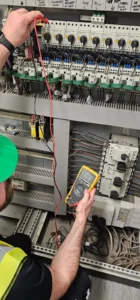
You do not need to be an electrician to spot the most common safety issues with a domestic fuse box or consumer unit replacement Aberdeen. A 3 minute visual self check covers the indicators that matter most: the type of unit, whether RCD protection is fitted, signs of overheating, condition of accessories, and obvious physical damage. This guide walks through exactly what to look for, what is safe to do yourself, and when to call a NICEIC certified electrician for a closer inspection. The check is a useful periodic exercise (annually is sensible) and is also the right first step if you have noticed any unusual behaviour from the electrical installation.
Important: what NOT to do
Before starting the self check, two clear safety boundaries:
- Do not remove the consumer unit cover. The cover keeps live components contained. Removing it exposes parts that operate at mains voltage. Only a qualified electrician with appropriate equipment should open the unit beyond the standard operating cover.
- Do not press the test buttons on RCDs unless you have planned for the resulting outage. Pressing the test button trips the RCD and disconnects the circuits it protects. This is a useful test, but it should be done at a planned moment, not while you have important work in progress.
The self check below is a visual inspection only. Everything covered here can be done by looking at the unit and listening for any unusual sounds, with the power on and the cover in place.
The 3 minute self check (step by step)
Step 1: Find your consumer unit
The consumer unit is typically located in one of these places:
- Under the stairs.
- In a hallway cupboard.
- In a utility room or kitchen.
- In an entrance lobby or porch.
- In an integral garage close to the meter.
For Scottish flats, the consumer unit is often near the front door. For granite tenements, it may be in a stair landing meter cupboard with shared access.
Step 2: Identify what type of unit you have
Look at the unit and identify which of the following it is:
Rewireable fuse board: A row of white or grey ceramic holders, each containing a piece of replaceable fuse wire visible through a small window. Typically 4 to 8 holders. If this is what you have, the unit is from the 1970s or 1980s and a replacement is the standard recommendation.
Older split load consumer unit: A row of black or grey rocker switches (MCBs) with a main switch on one side. May have one larger device that says “RCD” on it, or may have only a main switch with no RCD. If there is no RCD visible, the unit lacks comprehensive RCD protection and is likely to attract a EICR C1 C2 C3 codes on an EICR in Aberdeen.
Dual-RCD or full RCBO consumer unit: Two banks of breakers, each with its own RCD, or a row of identical breakers each with its own test button (full RCBO board). If this is your unit, it likely meets current standards.
Plastic enclosure: Most pre 2016 units have plastic enclosures. Modern units have metal clad enclosures. Plastic enclosures are not unsafe in themselves but appear as C3 advisory items on an EICR.
Step 3: Look for visible signs of damage or overheating
Examine the visible parts of the unit:
- Brown or black discolouration on the breaker bodies, the main switch, or the busbar. Discolouration indicates overheating.
- Visible scorch marks around any connection points or accessories. Any black mark or burn pattern is serious.
- Melted or distorted plastic at any point on the unit body or breaker housings. Plastic does not deform under normal conditions; deformation indicates significant heat damage.
- Broken or missing covers exposing internal components.
- Visible water staining on the unit or surrounding wall, suggesting damp or water ingress.
- Loose or wobbly breakers that are not securely fitted to the busbar.
Any of these signs warrants a call to an electrician for a closer inspection. Faithful Spark provides same day or next day attendance for any consumer unit showing signs of overheating or physical damage.
Step 4: Listen for unusual sounds
A consumer unit operating normally is silent. Listen for:
- Buzzing or humming sounds from inside the unit. A faint hum is normal on some installations under heavy load; a clear buzzing or persistent humming is not.
- Crackling or arcing sounds. These indicate a fault and the unit should be investigated immediately.
- Clicking sounds without obvious cause. Clicking can indicate a breaker that is starting to fail or an RCD that is responding to brief earth fault currents.
Step 5: Smell test
Approach the consumer unit and inhale gently:
- A burning smell from the unit or the surrounding area is a serious warning sign. Even faint burning smell indicates that something is heating to the point of degrading the surrounding plastic or insulation.
- An ozone or sharp metallic smell can indicate arcing inside the unit.
- A musty or damp smell may indicate water ingress affecting the unit.
Trust your nose. If something smells off near the consumer unit, it usually is.

RCD test (optional)
If your unit has RCDs and you want to confirm they trip correctly, you can carry out a manual test. The BS 7671 Wiring Regulations recommend RCDs be tested every 3 months. The test is simple but disconnects the circuits the RCD protects, so plan for the brief outage:
- Make sure no important equipment is running (computers, medical equipment, anything that needs continuous power).
- Identify which RCD you are testing and what circuits it protects.
- Press the test button on the RCD.
- The RCD should trip immediately, disconnecting its circuits. The lever should move to the off position.
- Wait a few seconds, then push the lever back to the on position to restore power.
If the RCD does not trip when the test button is pressed, the device is faulty. Stop using the affected circuits and call an electrician. A non functioning RCD provides no earth fault protection.
If pressing the test button does nothing (no click, no power loss), there is a problem with the RCD that needs investigation. Contact a NICEIC certified electrician for further inspection.
Look for warning signs in the rest of the home
Some consumer unit issues show up elsewhere in the home rather than at the unit itself. Look for:
- Sockets or switches that feel warm to the touch, particularly when nothing is plugged in or recently used.
- Lights flickering or dimming across multiple circuits, particularly when major appliances start up.
- Repeated breaker trips without obvious cause, suggesting a circuit at its capacity limit or a developing fault.
- Tingles or shocks from any metal appliance, indicating a fault that an RCD should disconnect (a working RCD would prevent any noticeable shock).
- Burning smell from any socket or appliance. Anywhere in the home, this needs immediate attention.
For a fuller catalogue of warning signs throughout the home, see our companion guide on signs you need a new fuse box.
When to call an electrician
Call a NICEIC certified electrician if your self check finds any of:
- Rewireable fuse board still in service.
- No RCD protection visible on the unit.
- Any sign of overheating, scorching, or melting.
- Any unusual sounds (buzzing, crackling, persistent humming).
- Any unusual smells (burning, ozone).
- Damaged or missing covers.
- Any RCD that does not trip when the test button is pressed.
- Any of the broader home warning signs listed above.
For C1 level issues (active overheating, burning smell, scorching, exposed live components), call immediately and isolate the affected circuit at the main switch if you can do so safely. Faithful Spark provides emergency attendance for serious Electrical Safety First issues across the Aberdeen and Aberdeenshire areas we cover.
If everything looks normal
If the self check reveals no warning signs:
- Note the type of unit and its approximate age (you can usually find a manufacturer label inside the cover at survey, but for the visual check, the visible style is enough to estimate the era).
- Plan to repeat the self check annually, ideally on the same date each year.
- If the unit is older than 25 years, plan a professional EICR inspection regardless of the visual condition. Older units can have hidden issues that the self check does not reveal.
- If you are planning any significant electrical work (ev charger, heat pump, extension), include a consumer unit assessment as part of the project planning.

Frequently asked questions
How often should I do a self check?
Annually is a reasonable frequency for the visual self check. The RCD test (pressing the test button) is recommended every 3 months by the Wiring Regulations. Both checks together take less than 5 minutes per quarter.
Does the self check replace an EICR?
No. The self check covers the visible exterior of the unit and obvious symptoms in the rest of the home. An EICR involves removing the cover, testing each circuit electrically, measuring earth continuity, RCD trip times, and many other parameters that the homeowner cannot measure visually. The self check complements the EICR rather than replacing it.
Is it safe to press the test button on the RCD?
Yes, with the cover in place. The test button is designed for homeowner use and does not expose anyone to live components. The button creates a small simulated earth fault that the RCD detects and trips on. The trip is the same as a normal fault trip; the RCD can be reset by pushing the lever back to the on position.
My consumer unit has no test buttons on the breakers. What does that mean?
Test buttons are typically only on RCDs and RCBOs. Standard MCBs do not have test buttons. If your unit has no test buttons at all, it likely lacks RCD protection entirely. This indicates either an older unit without RCDs, or a unit where the RCD has been replaced with a standard switch (which would be a serious issue). Contact an electrician for a professional assessment.
My EICR was satisfactory. Do I still need to do self checks?
Yes. The EICR is a snapshot at the inspection date. Conditions can change between inspections. Self checks identify problems that develop in the intervening period (a loose connection that develops over months, an accessory that gets damaged after the inspection, a fault that progresses gradually).
Book a professional consumer unit inspection
If your self check has identified any warning signs or you simply want a professional opinion, Faithful Spark provides NICEIC certified consumer unit inspections across Aberdeen and Aberdeenshire. Free inspection appointment, fixed price quote for any required work, and full electrical installation certificate at completion. See our pillar guide on consumer unit upgrades in Aberdeen.
Book My Consumer Unit Inspection
Faithful Spark Electricians. niceic approved. Local Aberdeen team. Consumer unit inspections, fuse box replacements, and Electrical Installation Certificates for Aberdeen, Peterhead, Ellon, Fraserburgh and across Aberdeenshire.