Skip to main content Skip to footer
Commercial Electrician in Aberdeen: What Businesses Need to Know
Running a business in Aberdeen, whether that is a shop, an office, a restaurant, or an industrial unit, comes with electrical responsibilities that go well beyond changing a light bulb when it fails. This guide explains what commercial electrical work actually covers, the legal obligations business owners carry, how often commercial premises need testing, and what to look for when choosing a contractor. It is written to inform business owners and property managers, not to sell you a specific job.
If you want current pricing and availability for commercial work once you have read this, our commercial electrician Aberdeen service page has the details.
What counts as commercial electrical work
Commercial electrical work covers anything carried out in a non domestic setting, and the scope is broader than most business owners expect. It typically includes:
- Periodic inspection and testing of the fixed installation, commonly called an EICR or fixed wire test.
- Installation and maintenance of lighting, including emergency lighting systems.
- Distribution board and consumer unit work for commercial premises, including three phase systems.
- Fire alarm and emergency system wiring.
- Power circuits for catering equipment, machinery, or specialist plant.
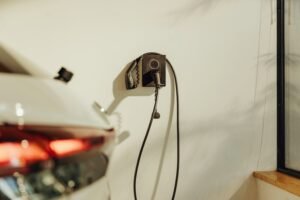
- EV charger installation for staff or customer parking.
- PAT testing of portable appliances used on the premises.
The exact requirements vary hugely depending on the type of business. A small office has very different needs to a commercial kitchen or a light industrial unit, and this affects both the scope of work and how often testing needs to happen.
Legal obligations for business owners
Under the Electricity at Work Regulations 1989, employers and business owners have a legal duty to ensure electrical systems are maintained in a safe condition so far as is reasonably practicable. This is a broad, ongoing duty rather than a single certificate you obtain once and forget about. Periodic inspection and testing, in the form of an EICR, is the standard way businesses demonstrate they are meeting this duty.
Unlike domestic EICRs, there is no single fixed interval written into law for every type of commercial premises. Instead, the recommended interval depends on the type of business and the environment the installation operates in. As a general guide:
- Offices and shops: typically every five years.
- Restaurants, kitchens, and hospitality premises: typically every five years, sometimes shorter if an insurer requires it.
- Industrial premises and workshops: typically every three years, given the harsher operating environment.
- Food processing and washdown environments: typically every three years, since moisture and washdown cleaning are particularly harsh on electrical accessories.
- HMOs and licensed premises: set by the relevant local licensing authority, which can be shorter than the general guidance above.
Insurers frequently ask for evidence of a current EICR, particularly after a claim, and some will not pay out on an electrical fire claim if the installation has not been tested within a reasonable period. It is always worth checking your specific policy conditions rather than assuming the general guidance above matches what your insurer expects. Our guide on commercial EICR testing in Aberdeen and Aberdeenshire covers this in more depth, and our wider explainer on what an EICR actually is is useful background if you are less familiar with the process.
Common commercial electrical jobs in Aberdeen
Office and retail fit outs
New tenants moving into commercial units across Aberdeen frequently need additional sockets, data points, and lighting circuits fitted to suit the layout of their business. This is usually combined with an initial EICR if the unit has not been tested recently, or if there is no record of previous testing.
Hospitality and catering
Restaurants, cafes, and takeaways have specific requirements around catering equipment circuits, extraction systems, and emergency lighting. Washdown cleaning and steam from cooking equipment place extra strain on electrical accessories, which is part of why three year testing intervals are common in this sector.
Industrial and workshop premises
Aberdeen’s industrial estates and workshop units often run heavier machinery on three phase supplies, which brings additional considerations around distribution boards and protective devices. Our guide on three phase consumer units in Aberdeen covers what is involved if your premises falls into this category.
EV charging for staff and customers
A growing number of Aberdeen businesses are installing EV chargers for staff parking or as a customer facility. This is a specialist installation requiring its own dedicated circuit and, in many cases, a load management system if multiple chargers are being fitted. Our guide on EV charger installation in Aberdeen covers the domestic side of this, and the principles carry across to small commercial installations with a few extra considerations around usage patterns and electrical capacity.
Landlord and multi tenant commercial buildings
Where a commercial building has multiple tenants, responsibility for electrical maintenance is often split between landlord and tenant depending on the lease terms. It is worth checking exactly who is responsible for what before assuming testing has been arranged by someone else.
What happens during a commercial EICR
The process follows the same underlying principles as a domestic EICR, but the scope and duration depend heavily on the size and complexity of the premises. A qualified inspector will:
- Visually inspect the distribution board, all circuits, and accessories for damage, wear, or non compliant installation.
- Test insulation resistance across circuits to check for degraded cabling.
- Check continuity of protective conductors to confirm earthing is intact.
- Test polarity at accessories and outlets.
- Measure earth fault loop impedance to confirm protective devices will operate correctly.
- Test RCD and RCBO operation at the correct trip currents and times.
Most small office or retail units can be tested within a single day, often scheduled outside trading hours to minimise disruption. Larger industrial sites or multi tenant buildings usually need a survey first so an accurate time and cost estimate can be provided.
Understanding your results
Commercial EICRs use the same coding system as domestic reports. Each finding is assessed and given a code depending on the level of risk.
- C1, Danger present. An immediate risk requiring the affected part of the installation to be made safe right away.
- C2, Potentially dangerous. A defect that could become dangerous under fault conditions, requiring remedial action within a reasonable timeframe.
- C3, Improvement recommended. Not dangerous, but below current best practice. Does not fail the report on its own.
- FI, Further investigation required. Something could not be fully assessed and needs follow up before the report is finalised.
For a more detailed explanation with examples, our guide on EICR C1, C2, and C3 codes explained covers each code in depth, largely from a domestic angle but the principles are identical for commercial premises.
What an Unsatisfactory result means for a business
An Unsatisfactory result means action is required, but it rarely means closing the business immediately unless a C1 defect has been found. The inspector’s report will set out exactly what needs remedying and how urgently. For most C2 findings, arranging the remedial work promptly and keeping a paper trail of when it was booked and completed is the sensible approach, particularly if an insurer or landlord ever asks for evidence of compliance.
Where the underlying issue is an outdated distribution board, a full upgrade to modern protective devices is often the most sensible long term fix. Amendment 4 of BS 7671, mandatory from October 2026, reinforces full RCBO style protection as the expected standard across new and upgraded installations, commercial premises included. Our guide on consumer unit upgrades with full RCBO protection explains the principle, even though larger commercial distribution boards involve additional considerations beyond a standard domestic unit.
What commercial electrical work costs in Aberdeen
Commercial pricing varies considerably depending on the size and type of premises, so most jobs beyond a very small unit are quoted after a site survey rather than from a fixed price list. As a general starting point, EICR testing for commercial premises begins from £150 for the smallest units, scaling up with the number of circuits and the complexity of the installation. Every figure quoted anywhere is a starting price, not a ceiling, and a written quote confirming scope and cost should always be provided before work begins.
Choosing a commercial electrical contractor
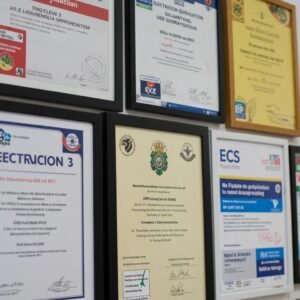
Commercial electrical work should always be carried out by a properly qualified, registered contractor. Look for NICEIC Approved Contractor status specifically, which covers a wider scope of work and higher assessment standards than a basic domestic registration. Ask to see evidence of public liability insurance appropriate to commercial premises, and check that the contractor holds the City & Guilds 2391 and 2392 qualifications for inspection and testing work if you need an EICR carried out.
Our guide on what it means to use an NICEIC approved electrician in Aberdeenshire explains the accreditation in more detail, and our comparison of SELECT versus NICEIC in Scotland covers the two main schemes operating in Scotland if you are trying to decide what to look for. NICEIC’s own guidance on Electrical Installation Condition Reports is a useful independent reference, and the underlying legal duty on employers sits within the Electricity at Work Regulations 1989 on legislation.gov.uk.
Working around business hours
Most commercial electrical work, from testing to installation, can be scheduled outside normal trading hours to minimise disruption. This is particularly relevant for retail and hospitality premises that cannot easily close during the day. It is worth discussing this at the quoting stage so out of hours work, if needed, is reflected accurately in the cost.
Frequently asked questions
How often does my Aberdeen office need an EICR?
Typically every five years for a standard office environment, though this can be shorter if your insurer specifies a shorter interval or if the premises has a harsher operating environment such as a workshop attached to the office.
Can commercial electrical testing be done outside working hours?
Yes, most commercial testing and installation work can be scheduled in the evening, at weekends, or during planned closure periods to avoid disrupting normal business operations.
Who is responsible for electrical testing in a rented commercial unit?
This depends on the lease. In many cases the landlord is responsible for the fixed installation while the tenant is responsible for their own equipment, but leases vary and it is always worth checking rather than assuming.
Does a small shop need the same testing as a large industrial unit?
The underlying legal duty is the same, but the scope and interval differ. Small shops are generally tested every five years, while industrial premises with heavier plant or harsher environments are typically tested every three years.
What happens if my business fails its EICR?
The report will list every finding with a code attached, so you know exactly what needs addressing and roughly how urgent each item is. C1 defects need immediate action. C2 defects should be resolved promptly, and it is sensible to keep a record of when remedial work was booked and completed in case an insurer or landlord later asks for evidence. C3 items are worth planning into future budgets even though they do not fail the report on their own.
Planning ahead for Amendment 4 of BS 7671
Amendment 4 of BS 7671 becomes mandatory from October 2026, and it affects commercial installations as much as domestic ones. The changes reinforce full RCBO style protection as the expected standard on new and upgraded distribution boards, and businesses planning any electrical upgrade work in the near future should factor this into their timeline rather than installing to older standards now and having to revisit the work again shortly afterwards. If your commercial premises has an EICR due around this period, it is worth discussing with your contractor whether any planned remedial work should already be specified to the updated standard.
This is particularly relevant for businesses with older distribution boards that have been patched over the years rather than replaced. A board with a mix of components installed at different times is harder to bring fully into line with the updated regulations than starting with a clean, modern installation, and it is often more cost effective in the long run to replace the whole board rather than continuing to patch it.
Insurance and electrical compliance
Beyond the legal duty under the Electricity at Work Regulations 1989, most business insurance policies include conditions relating to electrical safety, and a current EICR is frequently the evidence insurers ask for after any claim involving fire or electrical damage. It is worth reviewing your policy wording specifically rather than assuming your existing testing schedule automatically satisfies your insurer’s requirements, since some policies specify shorter intervals than the general guidance for your type of premises. Keeping certificates for all electrical work, not just EICRs, in an accessible file makes this much easier to produce quickly if a claim ever arises.
Related reading
For wider background on electrical compliance in Scotland, our guides on BS 7671 wiring regulations explained and recent changes across the UK electrical industry provide useful context. If your business is also considering an EV charger installation, see our guide on EV charger installation in Aberdeen.
In summary
Commercial electrical compliance in Aberdeen covers a wide range of work, from periodic testing to specialist installations, and the requirements differ significantly depending on the type of business you run. The core legal duty under the Electricity at Work Regulations 1989 applies to every business, but testing intervals and scope vary by sector. Choosing a properly registered contractor with the right qualifications is the most important decision you will make in staying compliant. When you are ready to discuss your premises, our commercial electrician Aberdeen page has current pricing and availability.